Back

Introduction to Aerobic Cellular Respiration definitions

Control buttons has been changed to "navigation" mode.
1/15
  • Aerobic Cellular Respiration

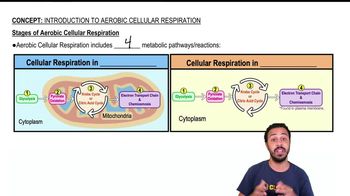
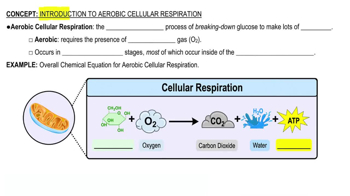
    A multi-stage process using oxygen to convert glucose into ATP, carbon dioxide, and water, mainly in mitochondria.
  • Mitochondria

    Organelle in eukaryotes where most stages of aerobic cellular respiration occur, often called the cell’s powerhouse.
  • Glycolysis

    The first stage of aerobic cellular respiration, occurring in the cytoplasm, breaking down glucose into smaller molecules.
  • Pyruvate Oxidation

    The second stage, converting products of glycolysis into molecules that enter the Krebs cycle, without directly generating ATP.
  • Krebs Cycle

    A series of reactions in mitochondria that further break down molecules from glycolysis, producing electron carriers and CO2.
  • Electron Transport Chain

    A sequence of proteins in mitochondria that transfer electrons, leading to ATP production via oxidative phosphorylation.
  • Chemiosmosis

    The movement of protons across a membrane, driving ATP synthesis during the final stage of aerobic cellular respiration.
  • ATP

    The main energy currency of the cell, produced in large amounts during aerobic cellular respiration.
  • Redox Reaction

    A chemical process involving electron transfer, where one molecule is oxidized and another is reduced.
  • Glucose

    A six-carbon sugar serving as the primary fuel for aerobic cellular respiration, with the formula C6H12O6.
  • Oxygen

    The final electron acceptor in aerobic cellular respiration, essential for efficient ATP production.
  • Prokaryotes

    Cells lacking mitochondria, performing most stages of aerobic cellular respiration in the cytoplasm.
  • Eukaryotes

    Cells containing mitochondria, where most aerobic cellular respiration stages take place.
  • Substrate Level Phosphorylation

    A method of ATP generation occurring directly in glycolysis and the Krebs cycle, without the electron transport chain.
  • Oxidative Phosphorylation

    ATP synthesis driven by the electron transport chain and chemiosmosis, producing most of the cell’s ATP.