Back

Introduction to Controlling Microbial Growth definitions

Control buttons has been changed to "navigation" mode.
1/15
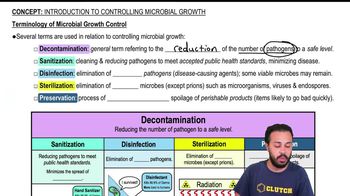
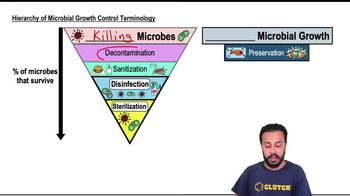
  • Decontamination

    Overall reduction of pathogens to a safe level, serving as the broadest category for microbial control in various scenarios.
  • Sanitization

    Cleaning process that reduces pathogens to meet public health standards, resulting in items that appear clean and are less toxic to humans.
  • Disinfection

    Elimination of most pathogens, though some resistant microbes may survive; more toxic than sanitization.
  • Sterilization

    Complete elimination of all microbes except prions, ensuring virtually zero survival of any microorganism.
  • Preservation

    Delaying spoilage of perishable products by slowing microbial growth, rather than killing microbes.
  • Physical Methods

    Approaches such as temperature control and filtration used to limit or eliminate microbial presence.
  • Chemical Methods

    Use of liquid or gaseous chemicals to control or eliminate microbes in various environments.
  • Irradiation

    Technique combining physical and chemical effects, using energy like UV or ionizing radiation to damage or kill microbes.
  • Endospore

    Highly resistant microbial structure that can survive disinfection but is eliminated by sterilization.
  • Aseptic Technique

    Set of practices in laboratories to prevent contamination and maintain sterile conditions.
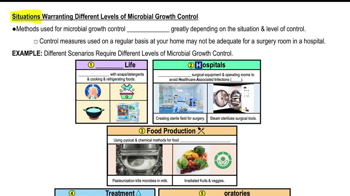
  • Pasteurization

    Heat-based process used in food production to kill microbes, especially in liquids like milk.
  • Healthcare-Associated Infection

    Infection acquired in a healthcare setting due to inadequate microbial control measures.
  • Personal Protective Equipment

    Gear such as gloves, masks, and goggles used to protect individuals from exposure to microbes.
  • Ultraviolet Light

    Form of non-ionizing radiation used in laboratories to kill microbes and prevent contamination.
  • Autoclave

    Device using steam under pressure to sterilize equipment, commonly used in hospitals and labs.