Back

Introduction to Pathogenic Toxins definitions

Control buttons has been changed to "navigation" mode.
1/13
  • Pathogenic Toxins

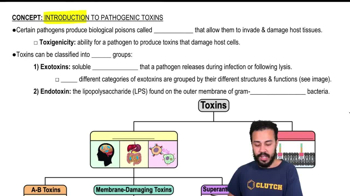
    Biological poisons from pathogens that enable invasion and destruction of host tissues.
  • Toxicogenicity

    A pathogen's capacity to generate substances that harm host cells.
  • Exotoxins

    Soluble proteins released by pathogens during infection or after lysis, causing host damage.
  • Endotoxins

    Lipopolysaccharide molecules in gram-negative bacteria's outer membrane, harmful to hosts.
  • AB Toxins

    A structural group of exotoxins with distinct subunits for binding and enzymatic activity.
  • Membrane-Damaging Toxins

    Exotoxins that disrupt host cell membranes, leading to cell injury or death.
  • Pore-Forming Toxins

    A type of membrane-damaging exotoxin that creates holes in host cell membranes.
  • Phospholipases

    Enzymatic exotoxins that degrade phospholipids in host membranes, compromising cell integrity.
  • Superantigens

    Exotoxins that excessively activate the immune system, causing widespread host cell damage.
  • Lipopolysaccharide

    A molecule in gram-negative bacteria's outer membrane, responsible for endotoxin activity.
  • Gram-Negative Bacteria

    Microorganisms with an outer membrane containing lipopolysaccharide, source of endotoxins.
  • Host Immune System

    The body's defense network, which can inadvertently harm host cells when overstimulated.
  • Pathogen Lysis

    The breakdown of infectious agents, leading to the release of exotoxins.