Skip to main content
Microbiology
My Course
Learn
Exam Prep
AI Tutor
Study Guides
Textbook Solutions
Flashcards
Explore
Try the app
My Course
Learn
Exam Prep
AI Tutor
Study Guides
Textbook Solutions
Flashcards
Explore
Try the app
Back
Introduction to Microbial Genetics definitions
1 student found this helpful
You can tap to flip the card.
Genome
You can tap to flip the card.
👆
Genome
Complete set of genetic material within a cell, encompassing all DNA present in an organism.
Track progress
Control buttons has been changed to "navigation" mode.
1/15
Related flashcards
Related practice
Recommended videos
Introduction to Microbial Genetics quiz #1
Introduction to Microbial Genetics
10 Terms
Introduction to Microbial Genetics
16. Microbial Genetics
3 problems
Topic
Brendan
Introduction to Mutations
16. Microbial Genetics
6 problems
Topic
Nicole
16. Microbial Genetics - Part 1 of 2
9 topics
14 problems
Chapter
Monica
16. Microbial Genetics - Part 2 of 2
8 topics
13 problems
Chapter
Nicole
02:04
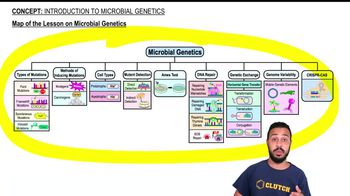
Map of the Lesson on Microbial Genetics
1771
views
20
rank
04:20
Introduction to Microbial Genetics
2977
views
59
rank
Terms in this set (15)
Hide definitions
Genome
Complete set of genetic material within a cell, encompassing all DNA present in an organism.
Gene Transfer
Movement of genetic information from one cell to another, enabling genetic diversity among microbes.
Vertical Gene Transfer
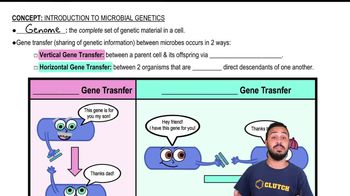
Transmission of genetic material from parent cell to offspring during cell replication and division.
Horizontal Gene Transfer
Exchange of genetic material between unrelated organisms, not involving parent-offspring relationships.
Donor Cell
Cell that provides genetic material during gene transfer, initiating the unidirectional exchange.
Recipient Cell
Cell that receives genetic material during gene transfer, acquiring new genetic traits.
Mutation
Change in the DNA sequence, which can alter genetic information and lead to genetic variation.
Point Mutation
Alteration affecting a single nucleotide in the DNA sequence, potentially impacting gene function.
Frameshift Mutation
Genetic change caused by insertions or deletions that shift the reading frame of the DNA sequence.
Spontaneous Mutation
Genetic alteration arising naturally without external influence, often due to errors in DNA replication.
Induced Mutation
Genetic change resulting from exposure to external agents such as chemicals or radiation.
Mutagen
Physical or chemical agent capable of causing changes in the DNA sequence, increasing mutation rates.
Carcinogen
Substance that can induce mutations leading to cancer, often overlapping with mutagens.
DNA Repair Mechanism
Cellular processes that detect and correct DNA damage, maintaining genetic stability.
CRISPR Cas9
Bacterial defense system that recognizes and cuts foreign genetic material, providing adaptive immunity.
 BackBack
 02:04
02:04