Skip to main content
Microbiology
My Course
Learn
Exam Prep
AI Tutor
Study Guides
Textbook Solutions
Flashcards
Explore
Try the app
My Course
Learn
Exam Prep
AI Tutor
Study Guides
Textbook Solutions
Flashcards
Explore
Try the app
Back
Introduction to Photosynthesis definitions
You can tap to flip the card.
Photosynthesis
You can tap to flip the card.
👆
Photosynthesis
Process in chloroplasts using sunlight, CO2, and water to produce glucose and oxygen, essential for autotrophs.
Track progress
Control buttons has been changed to "navigation" mode.
1/15
Related flashcards
Related practice
Recommended videos
Introduction to Photosynthesis quiz #1
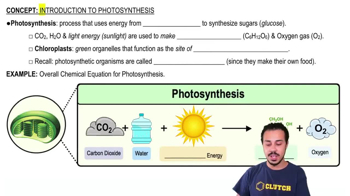
Introduction to Photosynthesis
10 Terms
Introduction to Photosynthesis
13. Photosynthesis
5 problems
Topic
Brendan
Leaf & Chloroplast Anatomy
13. Photosynthesis
1 problem
Topic
Brendan
13. Photosynthesis
9 topics
13 problems
Chapter
Nicole
03:32
Introduction to Photosynthesis
20163
views
413
rank
03:20
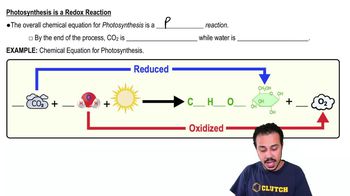
Photosynthesis is a Redox Reaction
16318
views
234
rank
07:55
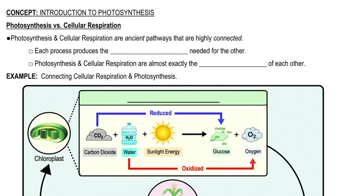
Photosynthesis vs. Cellular Respiration
16063
views
213
rank
1
comments
Terms in this set (15)
Hide definitions
Photosynthesis
Process in chloroplasts using sunlight, CO2, and water to produce glucose and oxygen, essential for autotrophs.
Chloroplast
Green organelle serving as the site where sunlight energy is converted into chemical energy during photosynthesis.
Autotroph
Organism capable of producing its own food from inorganic substances, typically through photosynthesis.
Glucose
Six-carbon sugar (C6H12O6) synthesized during photosynthesis, serving as a primary energy source for cells.
Oxygen
Gaseous byproduct released during photosynthesis, essential for aerobic respiration in most organisms.
Carbon Dioxide
Atmospheric gas (CO2) used as a reactant in photosynthesis, reduced to form glucose.
Water
Molecule (H2O) serving as a reactant in photosynthesis, oxidized to release oxygen.
Redox Reaction
Chemical process involving electron transfer, with one substance oxidized and another reduced, central to photosynthesis.
Oxidation
Loss of electrons from a molecule, as seen when water is converted to oxygen during photosynthesis.
Reduction
Gain of electrons by a molecule, exemplified by the conversion of carbon dioxide to glucose.
Cellular Respiration
Metabolic pathway in mitochondria converting glucose and oxygen into carbon dioxide, water, and ATP.
Mitochondria
Organelle where cellular respiration occurs, using glucose and oxygen to generate ATP energy.
ATP
Energy-carrying molecule produced during cellular respiration, powering cellular activities.
Solar Energy
Sunlight energy harnessed by chloroplasts to drive the synthesis of glucose in photosynthesis.
Chemical Equation
Symbolic representation showing reactants and products in processes like photosynthesis and cellular respiration.
 BackBack
 03:32
03:32