Back

Introduction to Taxonomy definitions

Control buttons has been changed to "navigation" mode.
1/15
  • Taxonomy

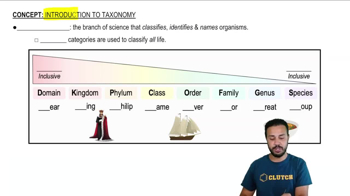
    Branch of science focused on classifying, identifying, and naming living organisms using hierarchical categories.
  • Domain

    Most inclusive taxonomic category, grouping all living organisms into three broad types based on cell structure.
  • Kingdom

    Major taxonomic rank below domain, further dividing organisms based on fundamental traits like cell type and nutrition.
  • Phylum

    Taxonomic category below kingdom, grouping organisms with similar body plans or major structural features.
  • Class

    Taxonomic rank below phylum, organizing organisms with shared characteristics within a phylum.
  • Order

    Taxonomic level below class, grouping families with common attributes and evolutionary traits.
  • Family

    Taxonomic category below order, clustering closely related genera based on structural similarities.
  • Genus

    Taxonomic group below family, containing species that are structurally similar and closely related.
  • Species

    Smallest taxonomic unit, representing a group of organisms capable of interbreeding and producing fertile offspring.
  • Prokaryotic Cell

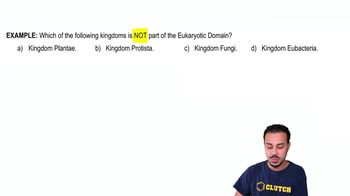
    Cell type lacking a nucleus and membrane-bound organelles, characteristic of bacteria and archaea.
  • Eukaryotic Cell

    Cell type containing a nucleus and membrane-bound organelles, found in animals, plants, fungi, and protists.
  • Phylogenetic Tree

    Diagram illustrating evolutionary relationships among organisms, often called the tree of life.
  • Producer

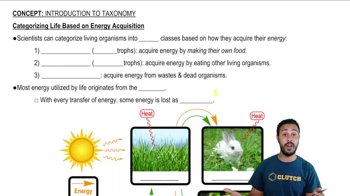
    Organism capable of making its own food from inorganic sources, forming the base of energy flow in ecosystems.
  • Consumer

    Organism that obtains energy by eating other living organisms, transferring energy up the food chain.
  • Decomposer

    Organism that breaks down dead matter and wastes, recycling nutrients back into the ecosystem.