Back

Introduction to the Complement System quiz

Control buttons has been changed to "navigation" mode.
1/15
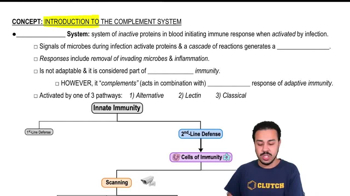
  • What is the complement system composed of?

    The complement system is composed of inactive proteins found in blood and tissues that can be activated during infections.
  • To which branch of immunity does the complement system belong?

    The complement system is part of innate immunity.
  • How does the complement system interact with adaptive immunity?

    The complement system complements adaptive immunity by working with antibodies, especially through the classical pathway.
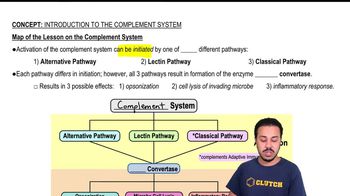
  • What are the three pathways that can activate the complement system?

    The three pathways are the alternative pathway, the lectin pathway, and the classical pathway.
  • Which complement activation pathway utilizes antibodies?

    The classical pathway utilizes antibodies.
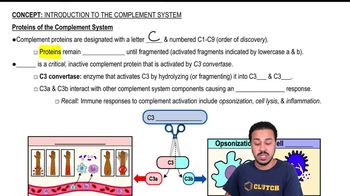
  • How are complement proteins designated and numbered?

    Complement proteins are designated with the letter 'C' and numbered from C1 to C9 based on their order of discovery.
  • What happens to complement proteins upon activation?

    Upon activation, complement proteins are fragmented into active forms, such as C3 being split into C3a and C3b.
  • What is the role of C3 convertase in the complement system?

    C3 convertase is an enzyme that activates C3 by cleaving it into C3a and C3b.
  • What immune responses can be triggered by complement activation?

    Complement activation can trigger opsonization, cell lysis, and inflammation.
  • What is opsonization and which complement fragment is involved?

    Opsonization is the process of marking microbes for phagocytosis, and C3b is the complement fragment involved.
  • Which complement fragment is primarily responsible for inflammation?

    C3a is primarily responsible for promoting inflammation.
  • What is the main function of the complement system as a scanning system?

    The complement system helps sense and detect signs of microbes in the body.
  • What is the result of cell lysis in the context of the complement system?

    Cell lysis results in the destruction of invading microbes.
  • Do all three complement activation pathways lead to the same enzyme formation?

    Yes, all three pathways result in the formation of C3 convertase.
  • Why is the complement system considered non-adaptable?

    The complement system does not change or adapt over time with repeated exposures to microbes, distinguishing it from adaptive immunity.