Back

Introduction to Viruses definitions

Control buttons has been changed to "navigation" mode.
1/15
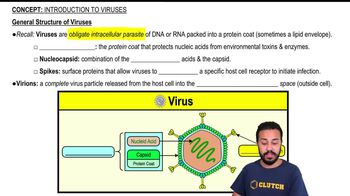
  • Obligate Intracellular Parasite

    Requires entry into a host cell to replicate, causing harm to the host while benefiting itself.
  • Capsid

    Protein shell surrounding and protecting viral genetic material from environmental threats.
  • Nucleocapsid

    Combined structure of viral genetic material and its protective protein coat.
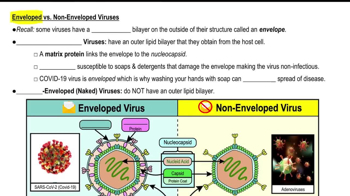
  • Envelope

    Lipid bilayer derived from the host cell, surrounding some viruses and making them vulnerable to soaps.
  • Matrix Protein

    Links the lipid envelope to the nucleocapsid, providing structural stability in enveloped viruses.
  • Spike

    Surface protein enabling attachment to specific host cell receptors, initiating infection.
  • Virion

    Complete, infectious virus particle released into the extracellular environment.
  • Nucleic Acid

    Genetic material of a virus, consisting of either DNA or RNA, but never both.
  • Enveloped Virus

    Virus possessing an outer lipid bilayer, often more susceptible to soaps and detergents.
  • Non-enveloped Virus

    Virus lacking a lipid bilayer, consisting only of a nucleocapsid; also called naked virus.
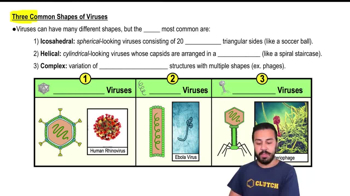
  • Icosahedral Shape

    Virus structure with roughly spherical appearance, composed of 20 triangular faces.
  • Helical Shape

    Virus structure resembling a spiral staircase, with cylindrical arrangement of capsid proteins.
  • Complex Shape

    Virus structure with varied, intricate components, often seen in bacteriophages.
  • Bacteriophage

    Virus with a complex structure that specifically infects bacterial cells.
  • Surface Protein

    Molecule embedded in the viral envelope or capsid, involved in host cell recognition and entry.