Back

Liquid Chemicals: Surface-Active Agents quiz

Control buttons has been changed to "navigation" mode.
1/15
  • What is the main function of surfactants (surface active agents) in controlling microbial growth?

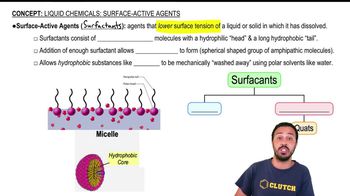
    Surfactants lower the surface tension of liquids, allowing the formation of micelles that trap and wash away hydrophobic substances like oil and bacteria.
  • What does it mean for a molecule to be amphipathic?

    An amphipathic molecule contains both hydrophilic (water-loving) and hydrophobic (water-fearing) groups.
  • How do micelles formed by surfactants help in cleaning?

    Micelles trap hydrophobic substances like oil in their core, allowing them to be washed away by water.
  • What are the two main types of surfactants discussed in this lesson?

    The two main types are soaps and detergents.
  • What are soaps chemically composed of?

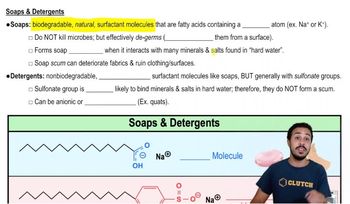
    Soaps are natural, biodegradable surfactants made from fatty acids and salts such as sodium or potassium.
  • Are soaps antimicrobial on their own?

    No, soaps alone do not kill microbes but are effective at removing them from surfaces (degerming).
  • Why do soaps form scum in hard water?

    Soaps react with minerals and salts in hard water to form soap scum, which can deteriorate fabrics and surfaces.
  • Why are detergents preferred over soaps for washing clothes?

    Detergents do not form scum in hard water and do not deteriorate fabrics, making them suitable for washing clothes.
  • What is a key chemical difference between soaps and detergents?

    Soaps are fatty acids with a carboxylic acid group, while detergents are synthetic and often contain a sulfonate group instead.
  • What are quats and what does the term stand for?

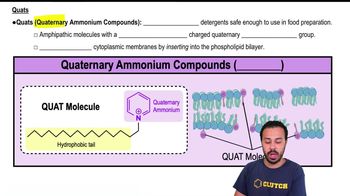
    Quats stands for quaternary ammonium compounds, which are cationic (positively charged) detergents.
  • What unique property do quats have compared to regular soaps and detergents?

    Quats have antimicrobial properties and can disrupt microbial cytoplasmic membranes, killing microbes.
  • How do quats disrupt microbial cells?

    Quats insert into the phospholipid bilayer of the cytoplasmic membrane, causing leaks and ultimately destroying the microbe.
  • Why are quats considered safe for use in food preparation areas?

    Quats are effective antimicrobials and are safe enough for use on surfaces in food preparation environments.
  • What is degerming and which surfactant is especially effective at it?

    Degerming is the removal of microbes from surfaces, and soaps are especially effective at this process.
  • What is the main structural feature of a micelle formed by surfactants?

    A micelle has hydrophobic tails facing inward to form a core and hydrophilic heads facing outward to interact with water.