Skip to main content
Microbiology
My Course
Learn
Exam Prep
AI Tutor
Study Guides
Textbook Solutions
Flashcards
Explore
Try the app
My Course
Learn
Exam Prep
AI Tutor
Study Guides
Textbook Solutions
Flashcards
Explore
Try the app
Back
Methods of Inducing Mutations definitions
You can tap to flip the card.
Induced Mutation
You can tap to flip the card.
👆
Induced Mutation
A deliberate change in DNA sequence caused by exposure to external agents, often used in research to study genetic variation.
Track progress
Control buttons has been changed to "navigation" mode.
1/15
Related flashcards
Related practice
Recommended videos
Methods of Inducing Mutations quiz
Methods of Inducing Mutations
15 Terms
Methods of Inducing Mutations
16. Microbial Genetics
5 problems
Topic
Brendan
Prototrophs vs. Auxotrophs
16. Microbial Genetics
3 problems
Topic
Nicole
16. Microbial Genetics - Part 1 of 2
9 topics
14 problems
Chapter
Monica
16. Microbial Genetics - Part 2 of 2
8 topics
13 problems
Chapter
Nicole
05:13
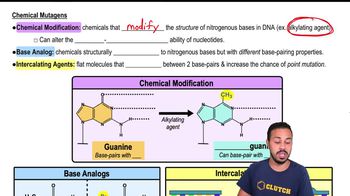
Chemical Mutagens
1497
views
19
rank
02:55
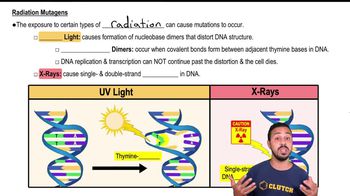
Radiation Mutagens
1356
views
17
rank
03:19
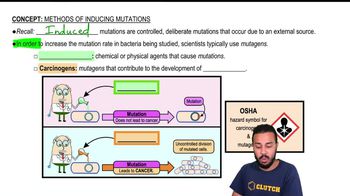
Methods of Inducing Mutations
1735
views
17
rank
Terms in this set (15)
Hide definitions
Induced Mutation
A deliberate change in DNA sequence caused by exposure to external agents, often used in research to study genetic variation.
Mutagen
Any chemical or physical agent capable of increasing the mutation rate by altering DNA structure or sequence.
Carcinogen
A specific mutagen that triggers mutations leading to uncontrolled cell growth and cancer development.
Alkylating Agent
A chemical that adds groups like methyl to DNA bases, altering their pairing properties and causing mismatches.
Base Analog
A molecule structurally similar to DNA bases, which can be mistakenly incorporated during synthesis, leading to improper pairing.
Intercalating Agent
A flat molecule that inserts between DNA base pairs, distorting the helix and increasing the chance of point mutations.
Thymine Dimer
A covalent linkage between adjacent thymine bases in DNA, often caused by UV light, which disrupts replication and transcription.
UV Light
A form of radiation that induces DNA mutations by forming covalent bonds between adjacent thymine bases.
X-ray
A high-energy radiation that causes single or double-stranded breaks in DNA, leading to mutations during repair.
Point Mutation
A change affecting a single nucleotide in the DNA sequence, often resulting from chemical or physical mutagens.
Methylguanine
A modified guanine base with a methyl group, which pairs abnormally with thymine instead of cytosine.
Hydrogen Bond
A weak interaction between DNA bases, crucial for base pairing and affected by chemical modifications.
DNA Replication
The process of copying genetic material, which can be disrupted by DNA lesions such as thymine dimers.
DNA Strand Break
A disruption in the continuity of the DNA backbone, caused by agents like X-rays, leading to mutations upon repair.
OSHA Symbol
A hazard warning sign indicating the presence of substances that are mutagenic or carcinogenic.
 BackBack
 05:13
05:13