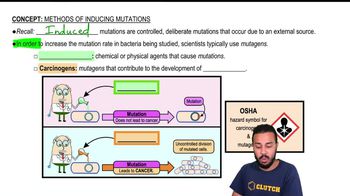
An induced mutation is a deliberate mutation caused by an external source, such as a mutagen.
What is a mutagen?
A mutagen is any chemical or physical agent that can cause mutations in DNA.
How do mutagens differ from carcinogens?
Mutagens cause mutations but do not necessarily lead to cancer, while carcinogens are mutagens that specifically cause cancer by leading to uncontrollable cell growth.
What is the role of the OSHA hazard symbol in relation to mutagens and carcinogens?
The OSHA hazard symbol warns that a substance is a mutagen or carcinogen and should be handled with care.
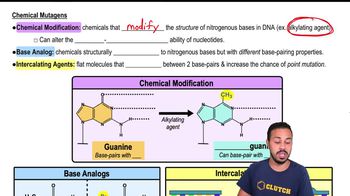
What are alkylating agents and how do they induce mutations?
Alkylating agents chemically modify nitrogenous bases, such as adding a methyl group to guanine, altering its base pairing and causing mismatches during DNA replication.
How does methylguanine differ from normal guanine in DNA?
Methylguanine forms only two hydrogen bonds and can pair with thymine instead of cytosine, leading to mutations.
What are base analogs and how do they cause mutations?
Base analogs are chemicals structurally similar to natural bases; when incorporated into DNA, they can pair incorrectly and cause mutations.
How can base analogs be mistakenly incorporated into DNA?
Base analogs can replace normal bases during DNA synthesis, leading to improper base pairing and mutations.
What are intercalating agents and how do they induce mutations?
Intercalating agents are flat molecules that insert between DNA base pairs, distorting the DNA structure and increasing the chance of point mutations.
What is the effect of proflavine as an intercalating agent?
Proflavine inserts itself between DNA base pairs, changing the DNA structure and increasing the likelihood of point mutations.
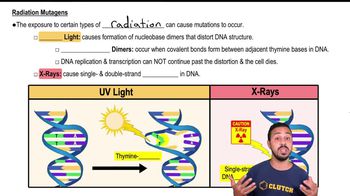
What types of radiation are commonly used as mutagens?
UV light and X-rays are commonly used radiation mutagens.
How does UV light induce mutations in DNA?
UV light causes the formation of thymine dimers, which distort DNA and block replication and transcription, often leading to cell death.
What are thymine dimers and why are they problematic?
Thymine dimers are covalent bonds between adjacent thymine bases; they distort DNA and disrupt replication and transcription.
How do X-rays cause mutations in DNA?
X-rays cause single and double-stranded breaks in DNA, and the repair of these breaks can introduce mutations.
Why can X-rays be used as mutagens in specific scenarios?
Because X-rays induce DNA strand breaks that, when repaired, often result in mutations, making them useful for controlled mutation studies.
 Back
Back
 05:13
05:13