Back

Molecular Koch's Postulates quiz

Control buttons has been changed to "navigation" mode.
1/15
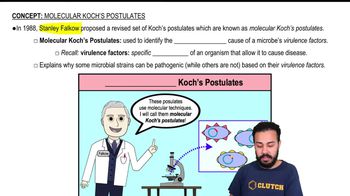
  • Who proposed the molecular Koch's postulates and in what year?

    Stanley Falkow proposed the molecular Koch's postulates in 1988.
  • What is the main purpose of molecular Koch's postulates?

    They are used to identify the molecular causes of a pathogen's virulence factors.
  • What are virulence factors?

    Virulence factors are specific traits of an organism that allow it to cause disease.
  • How do molecular Koch's postulates explain differences between pathogenic and non-pathogenic strains?

    They show that pathogenic strains possess certain virulence factor genes, while non-pathogenic strains do not.
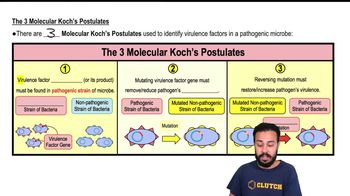
  • What does the first molecular Koch's postulate state?

    The suspected virulence factor gene or its product must be present in all pathogenic strains and absent in non-pathogenic strains.
  • What does the second molecular Koch's postulate require?

    Mutating the suspected virulence factor gene should reduce or remove the pathogen's ability to cause disease.
  • What does the third molecular Koch's postulate assert?

    Reversing the mutation in the virulence factor gene should restore the pathogen's virulence.
  • How many molecular Koch's postulates are there?

    There are three molecular Koch's postulates.
  • What conclusion can be drawn if all three molecular Koch's postulates are satisfied?

    The gene in question is confirmed as a virulence factor contributing to the pathogen's ability to cause disease.
  • What happens to a pathogenic strain if its suspected virulence factor gene is mutated?

    Its ability to cause disease is reduced or removed, making it non-pathogenic.
  • What must be absent in non-pathogenic strains according to the first postulate?

    The suspected virulence factor gene or its product must be absent.
  • What is indicated if reversing a mutation restores virulence?

    It confirms the gene's role in causing disease.
  • Why are molecular techniques important in molecular Koch's postulates?

    They allow scientists to identify and manipulate specific genes to test their role in virulence.
  • What is the effect of removing a virulence factor gene from a pathogenic microbe?

    It reduces or eliminates the microbe's ability to cause disease.
  • What is the significance of finding a virulence factor gene only in pathogenic strains?

    It suggests that the gene is responsible for the microbe's ability to cause disease.