Skip to main content
Microbiology
My Course
Learn
Exam Prep
AI Tutor
Study Guides
Textbook Solutions
Flashcards
Explore
Try the app
My Course
Learn
Exam Prep
AI Tutor
Study Guides
Textbook Solutions
Flashcards
Explore
Try the app
Back
Mutant Detection quiz
You can tap to flip the card.
What are the two main methods used for mutant detection?
You can tap to flip the card.
👆
What are the two main methods used for mutant detection?
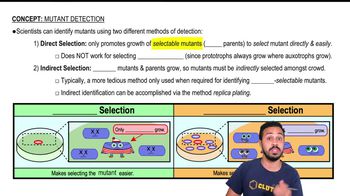
The two main methods are direct selection and indirect selection.
Track progress
Control buttons has been changed to "navigation" mode.
1/15
Related flashcards
Related practice
Recommended videos
Mutant Detection definitions
Mutant Detection
15 Terms
Mutant Detection
16. Microbial Genetics
3 problems
Topic
Monica
The Ames Test
16. Microbial Genetics
3 problems
Topic
Brendan
16. Microbial Genetics - Part 1 of 2
9 topics
14 problems
Chapter
Monica
16. Microbial Genetics - Part 2 of 2
8 topics
13 problems
Chapter
Nicole
06:49
Mutant Detection
1445
views
16
rank
1
comments
05:36
Replica Plating
1090
views
13
rank
Terms in this set (15)
Hide definitions
What are the two main methods used for mutant detection?
The two main methods are direct selection and indirect selection.
What is the key feature of direct selection in mutant detection?
Direct selection promotes the growth of only selectable mutants, making it easy to identify them.
Why can't direct selection be used to detect auxotroph mutants?
Auxotrophs require additional growth factors and grow alongside prototrophs, so direct selection cannot distinguish them.
What is an auxotroph?
An auxotroph is a mutant that requires additional growth factors to grow.
What is a prototroph?
A prototroph is a non-mutant organism that can grow without additional growth factors.
How does indirect selection differ from direct selection?
Indirect selection allows both mutants and non-mutants to grow, requiring identification of mutants among the crowd.
What analogy is used to describe the challenge of indirect selection?
Indirect selection is compared to finding 'Waldo' among many people, as mutants must be found among non-mutants.
What technique is commonly used for indirect selection of non-selectable mutants?
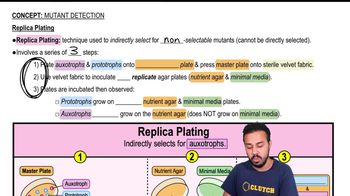
Replica plating is commonly used for indirect selection of non-selectable mutants like auxotrophs.
What is the first step in replica plating?
The first step is plating both auxotrophs and prototrophs onto a master plate.
What material is used to transfer colonies from the master plate in replica plating?
A sterile velvet fabric is used to transfer colonies from the master plate.
What are the two types of agar plates used in replica plating?
The two types are nutrient agar and minimal media agar plates.
Why do auxotrophs fail to grow on minimal media in replica plating?
Auxotrophs cannot grow on minimal media because it lacks the additional growth factors they require.
How are auxotroph mutants identified using replica plating?
Auxotrophs are identified by their absence on minimal media and presence on nutrient agar.
What does the presence of a colony on nutrient agar but not on minimal media indicate?
It indicates that the colony is an auxotroph mutant.
What is the purpose of replica plating in mutant detection?
Replica plating allows indirect selection and identification of non-selectable mutants such as auxotrophs.
 BackBack
 06:49
06:49