Back

Natural Killer Cells quiz

Control buttons has been changed to "navigation" mode.
1/15
  • What type of immunity are natural killer (NK) cells part of?

    NK cells are part of innate immunity, not adaptive immunity.
  • How do NK cells differ from T cells and B cells in terms of antigen recognition?

    NK cells lack specificity in antigen recognition, unlike T and B cells which require specific antigen recognition.
  • What is the main function of natural killer cells?

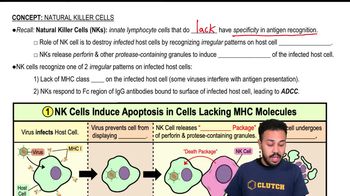
    The main function of NK cells is to destroy infected host cells by recognizing irregular patterns on their surfaces and inducing apoptosis.
  • What molecule do NK cells detect the absence of on infected cells?

    NK cells detect the absence of MHC class I molecules on infected cells.
  • Why might an infected cell lack MHC class I molecules?

    Some viruses interfere with antigen presentation, causing infected cells to lack MHC class I molecules.
  • What do NK cells release to induce apoptosis in target cells?

    NK cells release 'death packages' containing perforin and proteases to induce apoptosis.
  • What is the role of perforin released by NK cells?

    Perforin creates pores in the target cell membrane, facilitating cell death.
  • What is the function of proteases released by NK cells?

    Proteases degrade cellular proteins, contributing to apoptosis of the target cell.
  • What is antibody-dependent cellular cytotoxicity (ADCC)?

    ADCC is a process where NK cells recognize the Fc region of IgG antibodies bound to infected cells and induce apoptosis.
  • Which region of the IgG antibody do NK cells recognize during ADCC?

    NK cells recognize the Fc (constant) region of IgG antibodies during ADCC.
  • How do NK cells contribute to the immune response against viruses that evade T cell detection?

    NK cells can eliminate infected cells that lack MHC class I, which T cells cannot recognize.
  • Why are NK cells considered innate lymphoid cells?

    NK cells are considered innate lymphoid cells because they do not require specific antigen recognition and act as part of innate immunity.
  • How do NK cells work alongside adaptive immunity?

    NK cells can recognize antibodies produced by adaptive immunity and kill antibody-marked cells via ADCC.
  • What happens to a host cell after NK cell-induced apoptosis?

    The infected host cell is eliminated, preventing further spread of infection.
  • What are the two main irregular patterns NK cells recognize on target cells?

    NK cells recognize the absence of MHC class I molecules and the presence of IgG antibodies bound to cell surface antigens.