Back

Pattern Recognition Receptors (PRRs) quiz

Control buttons has been changed to "navigation" mode.
1/15
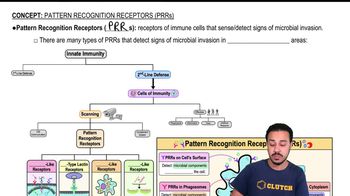
  • What are Pattern Recognition Receptors (PRRs) and what is their main function?

    PRRs are cell surface receptors of immune cells that detect signs of microbial invasion and host cell damage.
  • Name four main types of Pattern Recognition Receptors (PRRs).

    The four main types are Toll-like receptors (TLRs), C-type lectin receptors (CLRs), NOD-like receptors (NLRs), and RIG-like receptors (RLRs).
  • What do MAMPs and PAMPs stand for, and what do they indicate?

    MAMPs are Microbe-Associated Molecular Patterns and PAMPs are Pathogen-Associated Molecular Patterns; both indicate the presence of microbes or pathogens.
  • What are DAMPs and what do they signal to immune cells?

    DAMPs are Damage-Associated Molecular Patterns, which signal host cell damage to immune cells.
  • Where can Toll-like receptors (TLRs) be found in a cell?

    TLRs can be found on the cell surface or embedded in the membranes of endosomes and phagosomes.
  • What types of molecules do TLRs detect and what response can they initiate?

    TLRs detect MAMPs such as lipopolysaccharide, peptidoglycan, and viral nucleic acids, and can initiate immune responses like cytokine release.
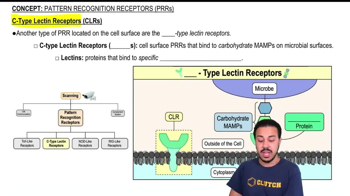
  • What is the primary function of C-type lectin receptors (CLRs)?

    CLRs bind to carbohydrate MAMPs on microbial surfaces and trigger immune responses upon binding.
  • Where are CLRs located and what do they specifically recognize?

    CLRs are located on the cell surface and specifically recognize carbohydrate MAMPs on microbes.
  • What are NOD-like receptors (NLRs) and where are they found?

    NLRs are cytoplasmic pattern recognition receptors found dissolved in the cytoplasm of immune cells.
  • What happens when NLRs detect intracellular MAMPs or DAMPs?

    When NLRs detect intracellular MAMPs or DAMPs, they form inflammasomes that activate pro-inflammatory cytokine production.
  • What is an inflammasome and what is its role in immunity?

    An inflammasome is a structure formed by NLRs that activates cytokine production, leading to inflammation to help eliminate microbes.
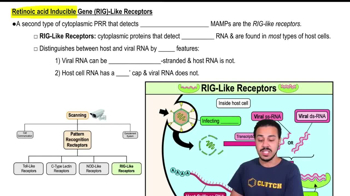
  • What do RIG-like receptors (RLRs) detect and where are they located?

    RLRs are cytoplasmic receptors that specifically detect viral RNA in the cytoplasm of host cells.
  • How do RLRs distinguish viral RNA from host cell RNA?

    RLRs distinguish viral RNA by its double-stranded nature and lack of a 5' cap and poly-A tail, features present in host cell RNA.
  • What immune response can RLRs initiate upon detecting viral RNA?

    RLRs can initiate immune responses such as the release of interferons when they detect viral RNA.
  • How do PRRs act as 'security cameras' in innate immunity?

    PRRs scan for signs of microbial invasion or cell damage, helping the immune system detect and respond to threats.