Skip to main content
Microbiology
My Course
Learn
Exam Prep
AI Tutor
Study Guides
Textbook Solutions
Flashcards
Explore
Try the app
My Course
Learn
Exam Prep
AI Tutor
Study Guides
Textbook Solutions
Flashcards
Explore
Try the app
Back
pH Scale quiz
You can tap to flip the card.
What does the pH scale measure in a solution?
You can tap to flip the card.
👆
What does the pH scale measure in a solution?
The pH scale measures the concentration of hydrogen ions (H+) in a solution.
Track progress
Control buttons has been changed to "navigation" mode.
1/15
Related flashcards
Related practice
Recommended videos
pH Scale definitions
pH Scale
14 Terms
pH Scale
4. Water
4 problems
Topic
Nicole
Acids and Bases
4. Water
4 problems
Topic
Brendan
4. Water
7 topics
14 problems
Chapter
Nicole
05:38
Buffers
17060
views
228
rank
11:05
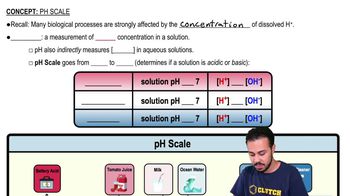
pH Scale
21364
views
260
rank
Terms in this set (15)
Hide definitions
What does the pH scale measure in a solution?
The pH scale measures the concentration of hydrogen ions (H+) in a solution.
What is the pH value of a neutral solution?
A neutral solution has a pH value of exactly 7.
How does the pH value relate to hydrogen ion concentration?
The pH value is inversely related to hydrogen ion concentration; lower pH means higher hydrogen ion concentration.
What pH range is considered acidic?
A solution is considered acidic if its pH is less than 7.
What pH range is considered basic?
A solution is considered basic if its pH is greater than 7.
How do acidic and basic solutions differ in terms of hydrogen and hydroxide ion concentrations?
Acidic solutions have more hydrogen ions than hydroxide ions, while basic solutions have more hydroxide ions than hydrogen ions.
What happens to the hydrogen ion concentration as the pH increases?
As the pH increases, the hydrogen ion concentration decreases.
Why is maintaining a stable pH important for living organisms?
Maintaining a stable pH is important because even slight changes can be harmful to living organisms.
What are buffers and what is their main function?
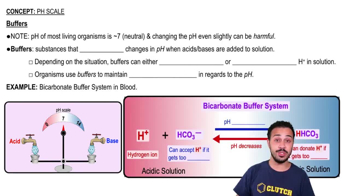
Buffers are substances that resist changes in pH when acids or bases are added, helping maintain a stable pH.
How do buffers help maintain pH homeostasis?
Buffers can either absorb excess hydrogen ions to increase pH or release hydrogen ions to decrease pH, keeping pH stable.
What is an example of a buffer system in the human body?
The bicarbonate buffer system in blood is an example of a buffer system in the human body.
What happens to the pH if too much acid is added to a solution without a buffer?
If too much acid is added without a buffer, the pH will decrease and the solution will become more acidic.
What does the bicarbonate ion (HCO3-) do when hydrogen ion concentration gets too high?
Bicarbonate ion (HCO3-) accepts hydrogen ions, which increases the pH and makes the solution less acidic.
What does HHCO3 do when hydrogen ion concentration gets too low?
HHCO3 can donate hydrogen ions, which decreases the pH and makes the solution less basic.
At what pH are the concentrations of hydrogen ions and hydroxide ions equal?
At pH 7, the concentrations of hydrogen ions and hydroxide ions are equal.
 BackBack
 05:38
05:38