Back

Prokaryotic Flagellar Structure definitions

Control buttons has been changed to "navigation" mode.
1/15
  • Filament

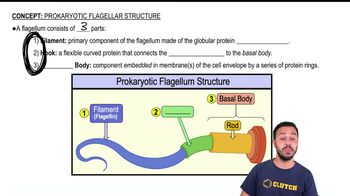
    Primary, whip-like structure of flagella composed of flagellin, responsible for most of the flagellum's length and movement.
  • Flagellin

    Globular protein forming the main structural component of the flagellar filament in prokaryotes.
  • Hook

    Flexible, curved protein connector linking the filament to the basal body, allowing rotational movement.
  • Basal Body

    Complex anchoring structure embedded in the cell envelope, consisting of a rod and multiple protein rings.
  • MS Ring

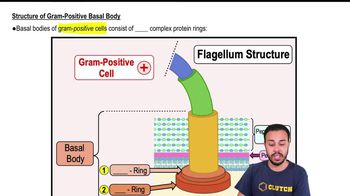
    Protein ring in the basal body, present in both gram-positive and gram-negative cells, situated in the plasma membrane.
  • C Ring

    Cytoplasmic protein ring of the basal body, found in both gram-positive and gram-negative flagella, involved in motor function.
  • L Ring

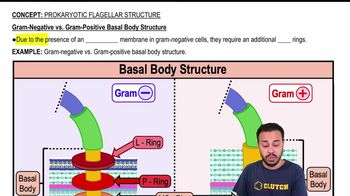
    Outer membrane-embedded protein ring unique to gram-negative basal bodies, providing additional anchoring.
  • P Ring

    Protein ring located in the peptidoglycan layer of gram-negative cells, stabilizing the basal body.
  • Gram-Positive Cell

    Bacterial cell type with a thick peptidoglycan layer and basal body containing only MS and C rings.
  • Gram-Negative Cell

    Bacterial cell type with a thin peptidoglycan layer, an outer membrane, and a basal body with four protein rings.
  • Peptidoglycan Layer

    Structural component of bacterial cell walls, thick in gram-positive and thin in gram-negative cells, anchoring flagellar rings.
  • Outer Membrane

    Additional membrane found in gram-negative bacteria, necessitating extra anchoring rings in the flagellar basal body.
  • Cell Envelope

    Combined layers surrounding the bacterial cell, including the plasma membrane, peptidoglycan, and, in some cases, an outer membrane.
  • Periplasm

    Space between the plasma membrane and outer membrane in gram-negative bacteria, containing the thin peptidoglycan layer.
  • Rod

    Central shaft within the basal body, connecting the hook to the protein rings and facilitating flagellar rotation.