Back

Prokaryotic Gene Expression quiz

Control buttons has been changed to "navigation" mode.
1/15
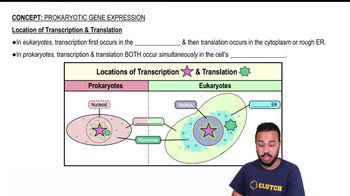
  • Where do transcription and translation occur in prokaryotic cells?

    Both transcription and translation occur simultaneously in the cytoplasm, specifically in the nucleoid region of prokaryotic cells.
  • Why can't transcription and translation occur simultaneously in eukaryotes?

    Because eukaryotes have a membrane-bound nucleus, transcription occurs in the nucleus and translation occurs in the cytoplasm, preventing simultaneous processes.
  • What is the nucleoid in prokaryotic cells?

    The nucleoid is a non-membrane-bound region in prokaryotic cells where the DNA is located and where transcription and translation occur.
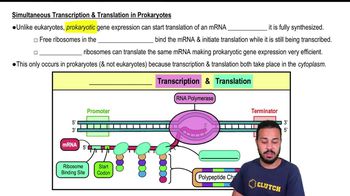
  • How does the efficiency of gene expression in prokaryotes compare to eukaryotes?

    Prokaryotic gene expression is more efficient because translation can begin before transcription is complete, with multiple ribosomes translating the same mRNA simultaneously.
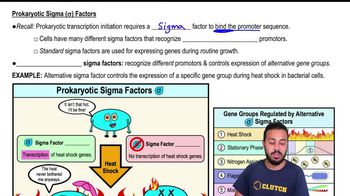
  • What role do sigma factors play in prokaryotic transcription?

    Sigma factors bind to promoter sequences and recruit RNA polymerase to initiate transcription in prokaryotes.
  • How do different sigma factors affect gene expression in prokaryotes?

    Different sigma factors recognize different promoters, allowing specific genes to be expressed in response to environmental conditions.
  • What is the difference between standard and alternative sigma factors?

    Standard sigma factors are used for routine gene expression, while alternative sigma factors control expression of specific gene groups needed in special conditions, such as heat shock.
  • What happens if a prokaryotic cell lacks the appropriate sigma factor during heat shock?

    If the sigma factor is absent, heat shock genes are not transcribed, and the cell cannot produce protective proteins, leading to cell death.
  • Does prokaryotic mRNA require post-transcriptional processing?

    No, prokaryotic mRNA does not require processing after transcription and lacks introns.
  • What are the main post-transcriptional modifications of eukaryotic mRNA?

    Eukaryotic mRNA undergoes capping, polyadenylation, and splicing to remove introns.
  • What is the difference between monocistronic and polycistronic mRNA?

    Monocistronic mRNA carries a single gene, while polycistronic mRNA carries multiple genes.
  • Which type of mRNA do eukaryotes typically produce?

    Eukaryotes typically produce only monocistronic mRNA.
  • Can prokaryotes produce both monocistronic and polycistronic mRNA?

    Yes, prokaryotes can produce both monocistronic and polycistronic mRNA.
  • What are spacers in polycistronic mRNA?

    Spacers are random non-coding sequences found between different genes in polycistronic mRNA.
  • How are spacers different from introns?

    Spacers are found between genes in polycistronic mRNA, while introns are non-coding sequences within a single gene and are removed during mRNA processing in eukaryotes.