Back

Pyruvate Oxidation quiz

Control buttons has been changed to "navigation" mode.
1/15
  • Where does pyruvate oxidation occur within the cell?

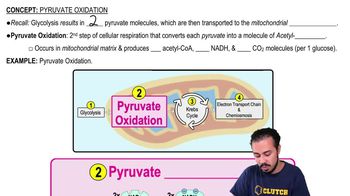
    Pyruvate oxidation occurs in the mitochondrial matrix.
  • How many pyruvate molecules are produced from one glucose during glycolysis?

    Two pyruvate molecules are produced from one glucose during glycolysis.
  • What is the main product formed from each pyruvate during pyruvate oxidation?

    Each pyruvate is converted into one Acetyl CoA molecule during pyruvate oxidation.
  • How many Acetyl CoA molecules are produced from one glucose after pyruvate oxidation?

    Two Acetyl CoA molecules are produced from one glucose after pyruvate oxidation.
  • What electron carrier is reduced during pyruvate oxidation?

    NAD+ is reduced to NADH during pyruvate oxidation.
  • How many NADH molecules are produced per glucose during pyruvate oxidation?

    Two NADH molecules are produced per glucose during pyruvate oxidation.
  • How many carbon dioxide molecules are released per glucose during pyruvate oxidation?

    Two carbon dioxide (CO2) molecules are released per glucose during pyruvate oxidation.
  • What happens to the electrons lost by pyruvate during oxidation?

    The electrons lost by pyruvate are gained by NAD+, forming NADH.
  • How many carbon atoms does each pyruvate molecule contain?

    Each pyruvate molecule contains three carbon atoms.
  • What happens to one of the carbons from each pyruvate during pyruvate oxidation?

    One carbon from each pyruvate is released as CO2 during pyruvate oxidation.
  • What is the fate of the Acetyl CoA produced in pyruvate oxidation?

    The Acetyl CoA produced enters the Krebs cycle, the third step of cellular respiration.
  • Which stage of cellular respiration does pyruvate oxidation represent?

    Pyruvate oxidation is the second stage of cellular respiration.
  • What are the three main products of pyruvate oxidation per glucose molecule?

    The three main products are 2 Acetyl CoA, 2 NADH, and 2 CO2 molecules.
  • Why is pyruvate oxidation considered an oxidation reaction?

    It is considered an oxidation reaction because pyruvate loses electrons.
  • What must happen to pyruvate before it can enter the Krebs cycle?

    Pyruvate must be converted into Acetyl CoA through pyruvate oxidation before entering the Krebs cycle.