Back

Reviewing the Environmental Factors of Microbial Growth definitions

Control buttons has been changed to "navigation" mode.
1/15
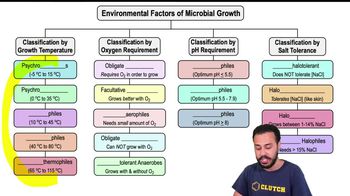
  • Psychrophiles

    Organisms thriving in extremely cold environments, growing best between -5°C and 15°C.
  • Psychrotrophs

    Microbes growing in cool environments, such as refrigerators, with a range of 0°C to 35°C.
  • Mesophiles

    Microbes that grow optimally at moderate temperatures, including human body temperature, between 10°C and 45°C.
  • Thermophiles

    Microbes adapted to hot environments, with optimal growth between 40°C and 80°C.
  • Hyperthermophiles

    Organisms that flourish in extremely hot environments, growing best between 65°C and 115°C.
  • Obligate Aerobes

    Microbes that require oxygen for growth and cannot survive in its absence.
  • Facultative Anaerobes

    Microbes that grow with or without oxygen but exhibit better growth when oxygen is present.
  • Microaerophiles

    Microbes needing only a small amount of oxygen; both excess and absence of oxygen are harmful.
  • Obligate Anaerobes

    Microbes that cannot grow in the presence of oxygen and require oxygen-free environments.
  • Aerotolerant Anaerobes

    Microbes that grow equally well with or without oxygen, unaffected by its presence.
  • Acidophiles

    Microbes with an optimum pH below 5.5, thriving in acidic environments.
  • Neutrophiles

    Microbes preferring near-neutral pH, with optimal growth between pH 5.5 and 7.9.
  • Alkalophiles

    Microbes that grow best at basic or alkaline pH values, typically at or above pH 8.
  • Halotolerant

    Microbes capable of surviving moderate salt concentrations, such as those found on human skin.
  • Halophiles

    Microbes that require high salt concentrations for growth, thriving in environments above 15% sodium chloride.