Back

Scientific Method quiz

Control buttons has been changed to "navigation" mode.
1/15
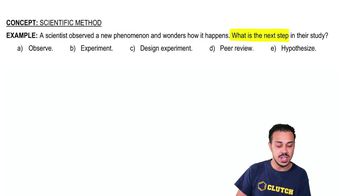
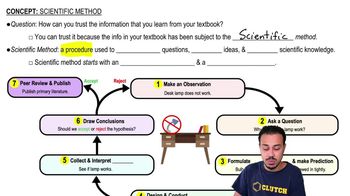
  • What is the first step of the scientific method?

    The first step is to make an observation and ask a question based on that observation.
  • What is a hypothesis in the context of the scientific method?

    A hypothesis is a proposed and testable explanation for an observation that answers both what will happen and why it will happen.
  • How does a prediction differ from a hypothesis?

    A prediction is an expected outcome of an event that answers only what will happen, while a hypothesis also explains why it will happen.
  • What is the purpose of peer review in the scientific method?

    Peer review involves having others check your scientific process for errors before publishing your results.
  • Why can you trust the information in your science textbook?

    Because it has been subjected to the scientific method and peer review, ensuring its reliability.
  • What should you do if your experiment does not support your hypothesis?

    You should reject the original hypothesis and repeat the scientific method with a new hypothesis.
  • What is a scientific theory?

    A scientific theory is a broad, testable hypothesis supported by a large body of evidence and many observations.
  • Can a hypothesis or theory ever be proven true?

    No, hypotheses and theories can never be proven true, only supported by evidence or falsified.
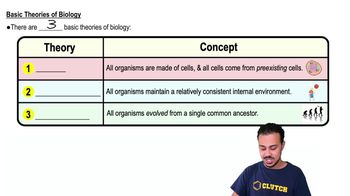
  • What does the cell theory state?

    The cell theory states that all living organisms are made of cells and all cells come from preexisting cells.
  • What does the homeostasis theory state?

    The homeostasis theory states that all living organisms maintain a relatively consistent internal environment.
  • What does the theory of evolution state?

    The theory of evolution states that all living organisms evolved from a single common ancestor.
  • What is the main difference between a theory and a hypothesis?

    A theory is broader, supported by more evidence, and explains many observations, while a hypothesis is more specific and testable.
  • What step follows drawing conclusions in the scientific method if your hypothesis is supported?

    If your hypothesis is supported, the next step is peer review and publishing your results.
  • Why are theories considered falsifiable?

    Theories are considered falsifiable because future evidence could prove them incorrect.
  • What is the role of experimentation in the scientific method?

    Experimentation is used to test the hypothesis and collect data to support or refute it.