Back

Sporulation quiz

Control buttons has been changed to "navigation" mode.
1/15
  • What triggers the initiation of sporulation in a vegetative cell?

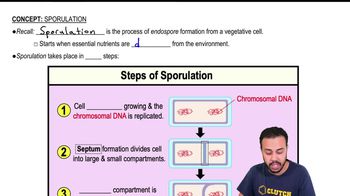
    Sporulation is triggered when a vegetative cell detects nutrient depletion and unfavorable environmental conditions.
  • What is the first step of sporulation?

    The first step is the cessation of cell growth and the replication of chromosomal DNA.
  • What structure forms during the second step of sporulation, and what does it do?

    A septum forms, dividing the cell into a larger and a smaller compartment.
  • During which step is the smaller compartment engulfed by the larger compartment?

    In the third step, the smaller compartment is engulfed by the larger compartment.
  • What is the forespore, and when does it form?

    The forespore is a precursor to the endospore, formed during the fourth step after the smaller compartment is engulfed.
  • What happens to the forespore during the fourth step of sporulation?

    The forespore undergoes dehydration, which halts enzyme activity and puts it into a dormant state.
  • How is the mature endospore released from the cell?

    The mature endospore is released when the cell undergoes lysis in the final step of sporulation.
  • Why are endospores considered highly resistant?

    Endospores are highly resistant because they are dormant and can survive harsh, nutrient-depleted conditions.
  • What process allows an endospore to return to a vegetative state?

    The process is called germination, which occurs when favorable conditions return.
  • How does dehydration of the forespore contribute to its dormancy?

    Dehydration stops enzyme activity, helping the forespore enter a dormant state.
  • What is the main difference between a vegetative cell and an endospore?

    A vegetative cell is metabolically active, while an endospore is dormant and highly resistant.
  • What is the role of the cortex and coat layers in endospore formation?

    The cortex and coat layers protect the forespore and contribute to the endospore's resistance.
  • What happens to the original cell after the endospore is released?

    The original cell lyses, releasing the mature endospore into the environment.
  • Is germination the same as sporulation? Explain.

    No, germination is the process where an endospore returns to a vegetative cell, which is the opposite of sporulation.
  • Why is sporulation considered a survival mechanism for bacteria?

    Sporulation allows bacteria to survive periods of nutrient depletion and harsh conditions by forming resistant endospores.