Skip to main content
Microbiology
My Course
Learn
Exam Prep
AI Tutor
Study Guides
Textbook Solutions
Flashcards
Explore
Try the app
My Course
Learn
Exam Prep
AI Tutor
Study Guides
Textbook Solutions
Flashcards
Explore
Try the app
Back
Steps of DNA Replication definitions
You can tap to flip the card.
Topoisomerase
You can tap to flip the card.
👆
Topoisomerase
Enzyme that relieves strain caused by DNA supercoiling ahead of the replication fork, ensuring smooth progression of replication.
Track progress
Control buttons has been changed to "navigation" mode.
1/14
Related flashcards
Related practice
Recommended videos
Steps of DNA Replication quiz
Steps of DNA Replication
15 Terms
Steps of DNA Replication
14. DNA Replication
4 problems
Topic
Brendan
DNA Repair
14. DNA Replication
3 problems
Topic
Nicole
14. DNA Replication
10 topics
14 problems
Chapter
Brendan
09:29
Steps of DNA Replication
15583
views
184
rank
Terms in this set (14)
Hide definitions
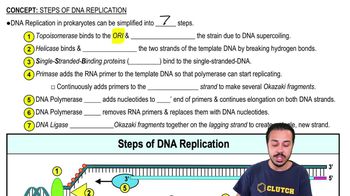
Topoisomerase
Enzyme that relieves strain caused by DNA supercoiling ahead of the replication fork, ensuring smooth progression of replication.
Origin of Replication
Specific DNA sequence where the process of making new DNA strands begins, attracting key enzymes to start replication.
Replication Fork
Y-shaped region where the double helix is unwound, allowing new DNA strands to be synthesized.
Helicase
Enzyme that unwinds the DNA double helix by breaking hydrogen bonds, creating single-stranded templates.
Single-Stranded Binding Proteins
Proteins that stabilize and protect single-stranded DNA, preventing reannealing and degradation during replication.
Primase
Enzyme that synthesizes short RNA primers, providing starting points for DNA polymerases to build new DNA.
RNA Primer
Short nucleic acid sequence that provides a free 3' hydroxyl group for DNA polymerase to initiate DNA synthesis.
Leading Strand
New DNA strand synthesized continuously in the same direction as the replication fork movement.
Lagging Strand
New DNA strand synthesized discontinuously in short fragments, opposite to the replication fork movement.
Okazaki Fragments
Short DNA segments formed on the lagging strand, later joined to create a continuous DNA molecule.
DNA Polymerase III
Main enzyme that extends new DNA by adding nucleotides to the 3' end of primers on both strands.
DNA Polymerase I
Enzyme that removes RNA primers and replaces them with DNA nucleotides during replication.
DNA Ligase
Enzyme that covalently links Okazaki fragments, sealing nicks to form a continuous DNA strand.
Hydrogen Bonds
Weak interactions between complementary DNA bases, broken during strand separation in replication.
 BackBack
 09:29
09:29