What is the main function of topoisomerase (DNA gyrase) during DNA replication in prokaryotes?
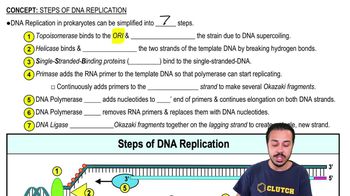
Topoisomerase relieves DNA supercoiling ahead of the replication fork, preventing strain that could inhibit replication.
Which enzyme unwinds the DNA double helix at the origin of replication?
Helicase unwinds the DNA by breaking hydrogen bonds between the two strands, creating single-stranded DNA.
What role do single-stranded binding proteins (SSBs) play during DNA replication?
SSBs bind to single-stranded DNA to prevent reannealing and protect the DNA from degradation.
Why are RNA primers necessary in DNA replication?
RNA primers provide a free 3' hydroxyl group for DNA polymerases to initiate DNA synthesis.
Which enzyme synthesizes RNA primers on the DNA template?
Primase synthesizes short RNA primers on the DNA template to start DNA replication.
How many RNA primers are needed on the leading strand compared to the lagging strand?
Only one RNA primer is needed on the leading strand, while multiple primers are continuously added to the lagging strand.
What are Okazaki fragments and on which strand are they formed?
Okazaki fragments are short DNA segments formed on the lagging strand during discontinuous DNA synthesis.
Which enzyme extends the DNA from the RNA primers during replication?
DNA polymerase III extends the DNA from the primers in the 5' to 3' direction on both leading and lagging strands.
In which direction does DNA polymerase III synthesize new DNA?
DNA polymerase III synthesizes new DNA in the 5' to 3' direction.
What is the function of DNA polymerase I during DNA replication?
DNA polymerase I removes RNA primers and replaces them with DNA nucleotides.
Which enzyme covalently links Okazaki fragments together?
DNA ligase covalently joins Okazaki fragments on the lagging strand to form a continuous DNA strand.
At which step does the DNA polymerase III begin to function during replication?
DNA polymerase III begins to function after RNA primers are added by primase, extending the DNA from the primers.
What would happen if single-stranded binding proteins did not bind to the single-stranded DNA?
Without SSBs, single-stranded DNA could reanneal or be degraded, disrupting the replication process.
Why is the lagging strand synthesized discontinuously?
The lagging strand is synthesized discontinuously because it is oriented opposite to the replication fork movement, requiring multiple primers and forming Okazaki fragments.
What is the overall purpose of DNA replication in prokaryotes?
The purpose of DNA replication is to produce an identical copy of the prokaryotic genome for cell division.
 Back
Back
 09:29
09:29