Back

Superinfections quiz

Control buttons has been changed to "navigation" mode.
1/15
  • What is a superinfection in the context of antimicrobial drug use?

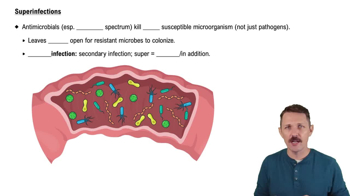
    A superinfection is a secondary infection that occurs during treatment for a primary infection, often because antimicrobial drugs kill susceptible microbes and allow resistant organisms to colonize.
  • How do broad-spectrum antibiotics increase the risk of superinfections?

    Broad-spectrum antibiotics kill a wide range of bacteria, including normal microbiota, leaving open niches for resistant microbes to colonize and cause superinfections.
  • What does the term 'super' in superinfection refer to?

    'Super' means the infection is superimposed or in addition to the first infection, not that it is superior or more powerful.
  • Why are normal microbiota important for preventing superinfections?

    Normal microbiota occupy niches in the body, preventing colonization by resistant or pathogenic organisms; their loss increases superinfection risk.
  • What is Candida and why is it a common superinfection?

    Candida is a yeast that is resistant to antibacterial drugs because it is a eukaryote, making it a common superinfection after broad-spectrum antibiotic use.
  • What are two common types of Candida superinfections?

    Vaginal yeast infections (vaginitis) and oral yeast infections (thrush) are common types of Candida superinfections.
  • Why does Candida thrive after broad-spectrum antibiotic treatment?

    Broad-spectrum antibiotics kill normal bacterial flora, creating space for Candida, which is not affected by these drugs, to colonize.
  • What is Clostridium difficile (C. Diff) and why is it significant?

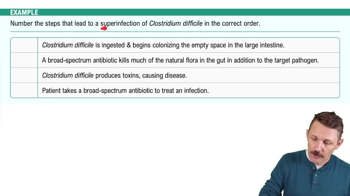
    Clostridium difficile is a resistant bacterium that can cause severe diarrhea and is often acquired in hospitals, making it a significant superinfection.
  • How does C. Diff cause superinfections?

    C. Diff survives broad-spectrum antibiotic treatment and colonizes the intestine, leading to severe illness and sometimes fatal outcomes.
  • Where are C. Diff superinfections most commonly acquired?

    C. Diff superinfections are most commonly acquired in hospitals.
  • What is the main advantage of broad-spectrum antibiotics?

    The main advantage is their ability to target a wide array of microbes, making them useful when the specific pathogen is unknown.
  • What is the main disadvantage of broad-spectrum antibiotics?

    They kill a large portion of natural microbiota, which can disrupt healthy body functions and increase the risk of superinfections.
  • How can narrow-spectrum antibiotics help prevent superinfections?

    Narrow-spectrum antibiotics target specific bacteria, minimizing disruption to normal microbiota and reducing the risk of superinfections.
  • What is dysbiosis and how is it related to superinfections?

    Dysbiosis is the imbalance of normal microbiota, often caused by broad-spectrum antibiotics, which can lead to superinfections.
  • Why is selective antimicrobial therapy important?

    Selective antimicrobial therapy helps maintain healthy microbiota and adaptive immunity, reducing complications like superinfections.