Back

Symbiotic Relationships quiz

Control buttons has been changed to "navigation" mode.
1/15
  • What is symbiosis in biology?

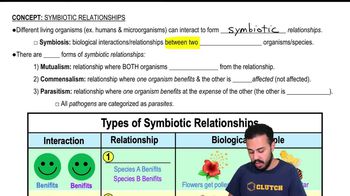
    Symbiosis refers to the specific biological interactions or relationships between two different organisms or species.
  • Name the three main forms of symbiotic relationships.

    The three main forms are mutualism, commensalism, and parasitism.
  • In mutualism, how are the organisms affected?

    In mutualism, both organisms benefit from the relationship.
  • Give an example of a mutualistic relationship.

    An example is the relationship between flowers and honeybees, where flowers are pollinated and bees collect nectar.
  • How does commensalism differ from mutualism?

    In commensalism, one organism benefits while the other is unaffected, whereas in mutualism both benefit.
  • What is an example of commensalism?

    Barnacles on whales is an example; barnacles benefit from transportation, while whales are unaffected.
  • Describe parasitism in terms of organism benefit and harm.

    In parasitism, one organism benefits at the expense of the other, which is harmed.
  • What is an example of a parasitic relationship?

    Ticks feeding on dogs is an example; ticks gain nutrients while dogs lose blood and may be harmed.
  • How are pathogens categorized in terms of symbiotic relationships?

    All pathogens are categorized as parasites because they benefit by harming their host.
  • In commensalism, what happens to the organism that does not benefit?

    The organism that does not benefit remains unaffected; it is neither helped nor harmed.
  • Why do barnacles benefit from attaching to whales?

    Barnacles benefit by using whales for transportation, which helps them access food.
  • How does the relationship between ticks and dogs illustrate parasitism?

    Ticks benefit by feeding on the dog's blood, while the dog is harmed by blood loss and potential infection.
  • What do both species gain in a mutualistic relationship?

    Both species gain benefits that help them survive or thrive.
  • Can you name a mutualistic relationship involving plants?

    Yes, flowers and honeybees have a mutualistic relationship where both benefit.
  • What is the main difference between commensalism and parasitism?

    In commensalism, one organism benefits and the other is unaffected, while in parasitism, one benefits and the other is harmed.