Back

Syphilis quiz

Control buttons has been changed to "navigation" mode.
1/15
  • What is the causative agent of syphilis and what is its shape?

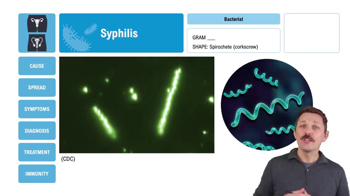
    Syphilis is caused by the gram-negative spirochete Treponema pallidum, which has a corkscrew or spiral shape.
  • How does Treponema pallidum invade host tissues?

    Its corkscrew motility allows it to spiral into tissues, enabling rapid invasion from the infection site.
  • What is antigenic variation and how does it help Treponema pallidum?

    Antigenic variation is the ability to change surface antigens, helping the bacterium evade detection by the immune system.
  • What is a chancre and why is it important in syphilis transmission?

    A chancre is a painless, hard sore at the infection site containing contagious fluids, which is the main source of syphilis transmission.
  • How can syphilis be transmitted from mother to fetus?

    Syphilis can cross the placenta during pregnancy, causing congenital syphilis with severe effects on the fetus.
  • What are the four stages of syphilis infection?

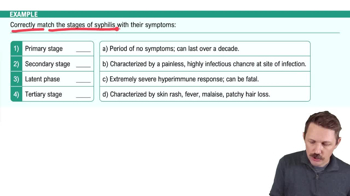
    The stages are primary (chancre), secondary (rash and mouth sores), latent (asymptomatic), and tertiary (gummas, neurosyphilis, cardiovascular damage).
  • What characterizes the primary stage of syphilis?

    The primary stage features a small, painless, hard chancre at the infection site, which often goes unnoticed.
  • What symptoms are seen in the secondary stage of syphilis?

    Secondary stage symptoms include infectious skin rashes (often on palms and soles), mouth sores, fever, malaise, and patchy hair loss.
  • What happens during the latent stage of syphilis?

    The latent stage is asymptomatic and can last over ten years, with most people not being contagious during this period.
  • What are gummas and in which stage of syphilis do they occur?

    Gummas are rubbery lesions on skin and bones, characteristic of the tertiary stage of syphilis.
  • What is neurosyphilis and what symptoms can it cause?

    Neurosyphilis is a tertiary stage complication affecting the nervous system, causing blindness, paralysis, and dementia.
  • How is syphilis diagnosed in the primary stage?

    Diagnosis in the primary stage involves microscopic observation of spirochetes, often using fluorescent stains.
  • What are the two main types of antibody tests used for syphilis diagnosis?

    Non-treponemal tests detect antibodies indicative of tissue damage, while treponemal tests detect antibodies against T. pallidum.
  • What is the standard treatment for syphilis and its limitations?

    Penicillin G is used to treat syphilis, but it cannot reverse damage already caused in the tertiary stage.
  • Why are condoms only partially effective at preventing syphilis transmission?

    Condoms may not cover all areas where chancres can occur, so syphilis can still spread even with correct usage.