Back

The Lac Operon quiz

Control buttons has been changed to "navigation" mode.
1/15
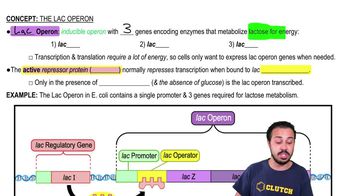
  • What type of operon is the lac operon and what does that mean?

    The lac operon is an inducible operon, meaning it is normally turned off but can be turned on (induced) under certain conditions.
  • Which three genes are found in the lac operon and what is their general function?

    The lac operon contains the genes lac z, lac y, and lac a, which encode enzymes necessary for metabolizing lactose.
  • What is the role of the lac I gene in the lac operon system?

    The lac I gene encodes the lac repressor protein, which regulates the operon by binding to the operator and blocking transcription when active.
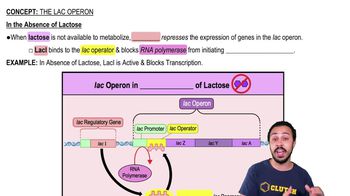
  • What happens to the lac operon in the absence of lactose?

    In the absence of lactose, the active lac I repressor binds to the operator, blocking RNA polymerase and preventing transcription of the operon genes.
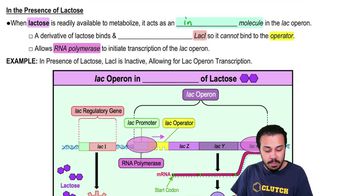
  • How does the presence of lactose affect the lac repressor protein?

    When lactose is present, it is converted to allolactose, which binds to and inactivates the lac repressor, preventing it from binding to the operator.
  • What is the function of allolactose in the lac operon system?

    Allolactose, a derivative of lactose, acts as an inducer by binding to the lac repressor and inactivating it, allowing transcription to proceed.
  • Why does the cell keep the lac operon turned off when lactose is absent?

    The cell turns off the lac operon to avoid wasting energy on producing enzymes that are not needed when lactose is not available.
  • What prevents RNA polymerase from transcribing the lac operon genes when the operon is off?

    The active lac I repressor binds to the operator, physically blocking RNA polymerase from initiating transcription.
  • Under what two conditions is the lac operon fully active?

    The lac operon is fully active only when lactose is present and glucose is absent.
  • What is the role of the operator in the lac operon?

    The operator is a DNA sequence where the lac repressor binds to regulate transcription of the operon genes.
  • What happens to the lac operon when the lac repressor is inactivated?

    When the lac repressor is inactivated, it cannot bind to the operator, allowing RNA polymerase to transcribe the operon genes.
  • What is the energy source that the lac operon enables E. coli to utilize?

    The lac operon enables E. coli to metabolize lactose as an energy source.
  • What is the relationship between the lac operon and E. coli?

    The lac operon was first discovered in E. coli and is a classic example of gene regulation in prokaryotes.
  • What is the consequence of expressing the lac operon genes when lactose is not present?

    Expressing the lac operon genes without lactose present wastes cellular energy, as the enzymes produced would have no substrate to act on.
  • How does the lac operon ensure that its genes are only expressed when needed?

    The lac operon uses a repressor protein that blocks transcription unless lactose (or allolactose) is present to inactivate the repressor, ensuring gene expression only when needed.