Skip to main content
Microbiology
My Course
Learn
Exam Prep
AI Tutor
Study Guides
Textbook Solutions
Flashcards
Explore
Try the app
My Course
Learn
Exam Prep
AI Tutor
Study Guides
Textbook Solutions
Flashcards
Explore
Try the app
Back
Transplantation definitions
You can tap to flip the card.
Autograft
You can tap to flip the card.
👆
Autograft
Tissue transplanted from one part of a person's body to another part of the same individual, eliminating immune rejection risk.
Track progress
Control buttons has been changed to "navigation" mode.
1/15
Related flashcards
Related practice
Recommended videos
Transplantation quiz
Transplantation
15 Terms
Transplantation
27. Immunological Disorders
3 problems
Topic
27. Immunological Disorders - Part 1 of 2
4 topics
11 problems
Chapter
27. Immunological Disorders - Part 2 of 2
4 topics
6 problems
Chapter
03:09
Graft-Versus-Host Disease (GVHD)
172
views
3
rank
04:07
Transplant Rejection
156
views
2
rank
04:21
Transplantation
128
views
3
rank
Terms in this set (15)
Hide definitions
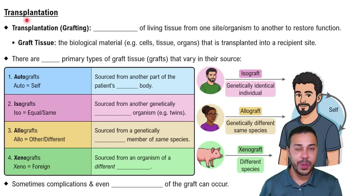
Autograft
Tissue transplanted from one part of a person's body to another part of the same individual, eliminating immune rejection risk.
Isograft
Tissue transferred between genetically identical individuals, such as identical twins, resulting in minimal immune response.
Allograft
Tissue transplanted between genetically different members of the same species, often requiring immunosuppression to prevent rejection.
Xenograft
Tissue or organ transplanted from a donor of a different species, such as a pig heart valve into a human recipient.
Graft
Biological material, including tissues, organs, or cells, transferred to restore function in a recipient.
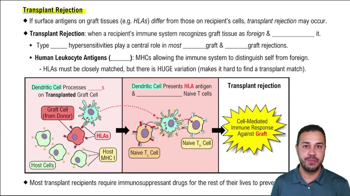
Transplant Rejection
Immune response where recipient cells recognize donor antigens as foreign, leading to attack and possible graft failure.
Human Leukocyte Antigen
Cell surface proteins, also known as MHC molecules, crucial for distinguishing self from non-self in transplantation.
MHC Molecule
Major proteins on cell surfaces that present antigens and are central to immune recognition during transplantation.
Type IV Hypersensitivity
Delayed, T cell-mediated immune reaction responsible for most transplant rejections, especially with non-identical donors.
Immunosuppressant
Medication used to dampen the immune response, often required lifelong after transplantation to prevent rejection.
Bone Marrow Transplant
Procedure replacing impaired marrow with donor cells, effectively transferring a new immune system to the recipient.
Graft-versus-Host Disease
Complication where donor immune cells attack recipient tissues after bone marrow transplantation, causing organ inflammation.
Dendritic Cell
Immune cell that processes and presents donor antigens to T cells, initiating transplant rejection.
Cytotoxic T Cell
Immune cell activated during rejection, responsible for attacking and destroying transplanted graft cells.
HLA Matching
Process of selecting donors with similar human leukocyte antigens to minimize immune-mediated graft rejection.
 BackBack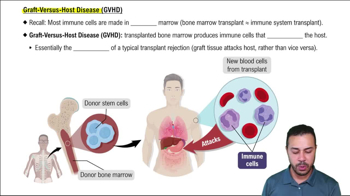
 03:09
03:09