What is transplantation in the context of medicine?
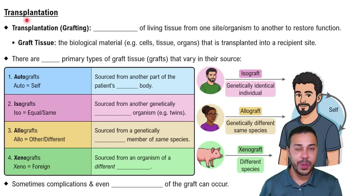
Transplantation refers to the transfer of living biological tissue from one site or organism to another to restore function.
What is an autograft?
An autograft is a transplant where the tissue is sourced from and given to the same individual.
What is an isograft?
An isograft is a transplant between two genetically identical individuals, such as identical twins.
What is an allograft?
An allograft is a transplant between two genetically different members of the same species.
What is a xenograft?
A xenograft is a transplant where the tissue is sourced from a different species.
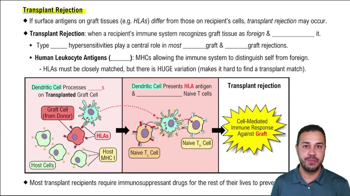
What triggers transplant rejection?
Transplant rejection is triggered when the recipient's immune system recognizes donor HLAs as foreign and attacks the graft.
What are HLAs and why are they important in transplantation?
HLAs, or human leukocyte antigens, are proteins that help the immune system distinguish self from foreign, and matching them is crucial to prevent rejection.
Which type of hypersensitivity is primarily involved in transplant rejection?
Type IV (delayed, T cell-mediated) hypersensitivity is primarily involved in most transplant rejections.
Why is it difficult to find a suitable donor for transplantation?
There is a huge amount of variation in HLA genes, making it rare for a random donor to be a suitable match.
Why do most transplant recipients require lifelong immunosuppressant drugs?
Immunosuppressants are needed to prevent the recipient's immune system from attacking the transplanted tissue.
What is graft-versus-host disease (GVHD)?
GVHD is a complication where donor immune cells from a bone marrow transplant attack the recipient's tissues.
How is GVHD different from typical transplant rejection?
In GVHD, the graft attacks the host, whereas in typical rejection, the host's immune system attacks the graft.
What organs are commonly affected by GVHD?
GVHD commonly causes inflammation and damage to the skin, liver, and gastrointestinal tract.
Why must the recipient's immune system be destroyed or suppressed before a bone marrow transplant?
The recipient's immune system must be suppressed to prevent it from attacking the donor bone marrow cells, ensuring transplant success.
Why are genetically identical donors, like identical twins, considered the best transplant donors?
Genetically identical donors have matching HLAs, greatly reducing the risk of transplant rejection.
 Back
Back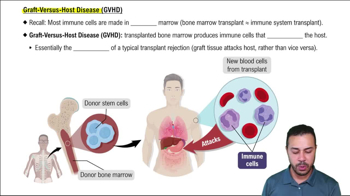
 03:09
03:09