What types of antibodies mediate Type II hypersensitivities?
Type II hypersensitivities are mediated by IgG and/or IgM antibodies targeting cell surface or extracellular antigens.
What is the main mechanism of cytotoxic Type II hypersensitivities?
The main mechanism is cell death, which can occur via complement-dependent or complement-independent pathways, leading to tissue damage.
What is antibody-dependent cellular cytotoxicity (ADCC)?
ADCC is when antibodies trigger cell death, often by recruiting immune cells like natural killer cells to destroy targeted cells.
What are two well-studied examples of cytotoxic Type II hypersensitivities?
Hemolytic transfusion reactions and hemolytic disease of the newborn (HDNB) are two well-studied examples.
How do non-cytotoxic Type II hypersensitivities differ from cytotoxic ones?
Non-cytotoxic Type II hypersensitivities target self cells and alter cell responses by inactivating or overstimulating cell receptors, leading to autoimmune disorders.
What autoimmune diseases are caused by non-cytotoxic Type II hypersensitivities?
Myasthenia gravis and Graves' disease are caused by non-cytotoxic Type II hypersensitivities.
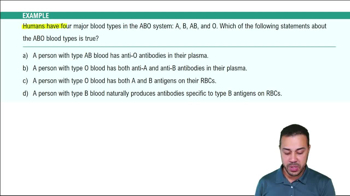
What determines the four main blood types in the ABO blood system?
The presence or absence of A and B carbohydrate antigens on red blood cells determines the four main blood types: A, B, AB, and O.
What antibodies are present in Type O blood?
Type O blood has both anti-A and anti-B antibodies because it lacks both A and B antigens.
Why is the donor's plasma not a concern in blood transfusion safety?
Because only the donor's red blood cells are transfused, not their plasma, so the recipient's antibodies interacting with donor antigens is what matters.
What is the Rh factor and how does it affect blood typing?
The Rh factor is a protein antigen on red blood cells; Rh positive individuals have it, while Rh negative individuals do not.
When do Rh-negative people produce anti-Rh antibodies?
Rh-negative people produce anti-Rh antibodies only after exposure to Rh antigens, such as through transfusion or pregnancy.
What is the 'Donate Rule' for blood transfusions?
You can donate blood to recipients whose red blood cells have at least your antigens or more.
What is the 'Receive Rule' for blood transfusions?
You can receive blood from donors whose red blood cells have at most your antigens or fewer.
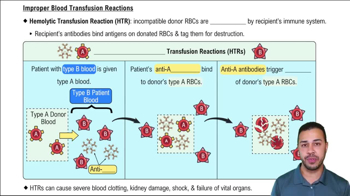
What happens during a hemolytic transfusion reaction (HTR)?
The recipient's antibodies attack incompatible donor red blood cells, causing lysis and potentially leading to inflammation, organ damage, or death.
How does RhoGAM prevent hemolytic disease of the newborn (HDNB)?
RhoGAM contains anti-Rh antibodies that bind fetal Rh antigens, preventing the mother's immune system from becoming sensitized and producing anti-Rh IgG antibodies.
 Back
Back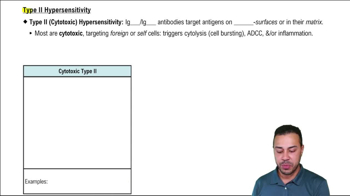
 06:45
06:45