Skip to main content
Microbiology
My Course
Learn
Exam Prep
AI Tutor
Study Guides
Textbook Solutions
Flashcards
Explore
Try the app
My Course
Learn
Exam Prep
AI Tutor
Study Guides
Textbook Solutions
Flashcards
Explore
Try the app
Back
Type IV Hypersensitivities quiz
You can tap to flip the card.
What is the main immune cell type responsible for type IV hypersensitivities?
You can tap to flip the card.
👆
What is the main immune cell type responsible for type IV hypersensitivities?
Type IV hypersensitivities are mediated by T cells, not B cells or antibodies.
Track progress
Control buttons has been changed to "navigation" mode.
1/15
Related flashcards
Related practice
Recommended videos
Type IV Hypersensitivities definitions
Type IV Hypersensitivities
15 Terms
Type IV Hypersensitivities
27. Immunological Disorders
5 problems
Topic
Reviewing the 4 Types of Hypersensitivities
27. Immunological Disorders
4 problems
Topic
27. Immunological Disorders - Part 1 of 2
4 topics
11 problems
Chapter
27. Immunological Disorders - Part 2 of 2
4 topics
6 problems
Chapter
04:10
Type IV Hypersensitivity
183
views
3
rank
01:53
Type IV Hypersensitivities Example 1
169
views
5
rank
03:47
1) Contact Dermatitis
170
views
3
rank
Terms in this set (15)
Hide definitions
What is the main immune cell type responsible for type IV hypersensitivities?
Type IV hypersensitivities are mediated by T cells, not B cells or antibodies.
Why are type IV hypersensitivities referred to as 'delayed' hypersensitivities?
They are called 'delayed' because the reaction typically peaks 24-72 hours after re-exposure to the antigen.
What must occur during the first exposure to an antigen for a type IV hypersensitivity to develop later?
Sensitization of T cells must occur during the first exposure, leading to the formation of memory T cells.
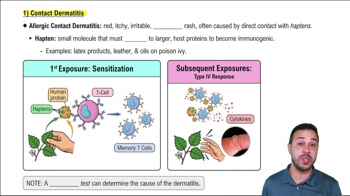
What is contact dermatitis and what causes it in the context of type IV hypersensitivity?
Contact dermatitis is an inflammatory skin rash caused by T cell-mediated responses to haptens like poison ivy oils.
What is a hapten and how does it trigger a type IV hypersensitivity?
A hapten is a small molecule that must bind to a host protein to become immunogenic and stimulate a T cell response.
Why does a person not get a rash the first time they touch poison ivy?
The first exposure only sensitizes the immune system; the rash occurs upon subsequent exposures when memory T cells react.
What is the typical time frame for the peak response of a type IV hypersensitivity after antigen re-exposure?
The peak response usually occurs 1 to 3 days (24-72 hours) after re-exposure.
How can type IV hypersensitivities lead to autoimmune diseases?
If T cells react to self-antigens due to a failure in self-tolerance, they can cause autoimmune diseases like type 1 diabetes.
What is the tuberculin skin test and what does it detect?
The tuberculin skin test checks for immune memory to TB proteins, indicating prior exposure but not active infection.
What is injected under the skin during a tuberculin skin test?
Purified protein derivative (PPD) from Mycobacterium tuberculosis is injected.
What does a positive tuberculin skin test indicate?
A positive test indicates prior exposure to TB-like proteins, but not necessarily active tuberculosis.
What is an 'induration' in the context of the tuberculin skin test?
An induration is a raised, red, and inflamed area of skin indicating a positive reaction.
Why can't the tuberculin skin test distinguish between current and past TB infection?
Because it only detects immune memory, not whether the infection is active or from past exposure or vaccination.
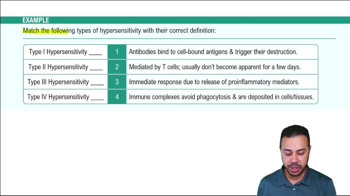
What is the memory tool 'ACID' used for in hypersensitivity types?
'ACID' helps remember the four types: Allergic (I), Cytotoxic (II), Immune complex (III), and Delayed (IV).
What diagnostic test can help determine the cause of contact dermatitis?
A patch test can be used to identify the specific substance causing the dermatitis.
 BackBack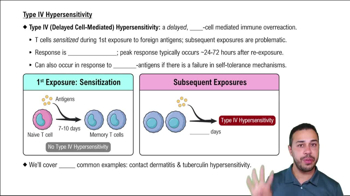
 04:10
04:10