Back

Viruses Evade the Immune Response quiz

Control buttons has been changed to "navigation" mode.
1/15
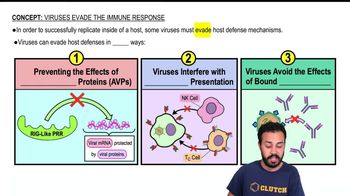
  • What are the three primary mechanisms viruses use to evade the immune response?

    Viruses evade the immune response by preventing antiviral protein effects, interfering with antigen presentation, and avoiding antibody effects.
  • How do some viruses prevent the effects of antiviral proteins (AVPs)?

    They coat their RNA with viral proteins to hide from cytoplasmic pattern recognition receptors (PRRs), blocking apoptosis and allowing viral replication.
  • What is the role of interferons in viral infection?

    Interferons are cytokines produced by infected cells that stimulate neighboring cells to produce antiviral proteins (AVPs).
  • What is a RIG-like receptor and its function in viral detection?

    A RIG-like receptor is a cytoplasmic pattern recognition receptor (PRR) that detects viral RNA inside host cells.
  • How do viral proteins protect viral RNA from host detection?

    Viral proteins bind to viral RNA, preventing PRRs like RIG-like receptors from recognizing and binding to it.
  • Why do viruses block apoptosis in infected cells?

    Blocking apoptosis prevents the infected cell from dying, allowing the virus to replicate and spread.
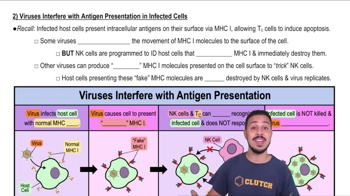
  • How do viruses interfere with antigen presentation?

    Viruses can prevent the movement of MHC class I molecules to the cell surface or produce fake MHC class I molecules.
  • What is the function of MHC class I molecules in immune defense?

    MHC class I molecules present intracellular antigens on the cell surface to alert cytotoxic T cells, which can induce apoptosis in infected cells.
  • How do natural killer cells respond to cells lacking MHC class I molecules?

    Natural killer cells identify and destroy host cells that lack MHC class I molecules.
  • What is the purpose of fake MHC class I molecules produced by viruses?

    Fake MHC class I molecules trick natural killer cells and cytotoxic T cells, preventing them from destroying infected cells.
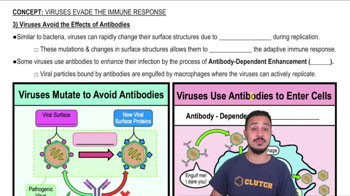
  • How do viruses evade the effects of antibodies?

    Viruses mutate their surface proteins, changing their structure so that existing antibodies are ineffective.
  • What is antibody-dependent enhancement (ADE) in viral infections?

    ADE is a process where antibodies facilitate viral entry into cells, such as macrophages, enhancing viral replication.
  • How do mutations in viral genomes help viruses evade the immune system?

    Mutations change viral surface structures, allowing viruses to avoid recognition and neutralization by antibodies.
  • What happens when a virus uses ADE to infect a macrophage?

    The virus is engulfed by the macrophage and can replicate inside it, evading destruction by the immune system.
  • Why is evading the immune response important for viral replication and spread?

    Evading the immune response allows viruses to replicate within the host undetected or unimpeded, leading to successful infection and spread.