 Back
BackAdaptive Immune System: Structure, Function, and Mechanisms
Study Guide - Smart Notes
 Tailored notes based on your materials, expanded with key definitions, examples, and context.
Adaptive Immune System
Overview and Purpose
The adaptive immune system is a highly specialized defense mechanism that enables the body to recognize and eliminate specific pathogens and their products. It builds upon the innate immune response and is characterized by its ability to target distinct invaders with precision.
Specificity: Targets unique molecular structures (antigens) on pathogens.
Inducibility: Activated only in response to specific antigens.
Clonality: Generates clones of lymphocytes specific to the encountered antigen.
Unresponsiveness to self: Normally does not attack the body’s own cells.
Memory: Remembers previous encounters for faster future responses.
Key Characteristics of Adaptive Immunity
Adaptive immunity is distinguished by four main features:
Specificity: Recognizes and responds to specific epitopes on antigens.
Tolerance to self: Prevents immune responses against self-antigens, failure of which leads to autoimmune diseases.
Minimal self-damage: Immune responses are regulated to avoid excessive tissue damage.
Immunological memory: Enables rapid and robust responses upon re-exposure to the same antigen.
Types of Leukocytes in Adaptive Immunity
Leukocytes, or white blood cells, are central to immune function. The two primary types involved in adaptive immunity are:
B cells: Mature in bone marrow, produce antibodies (immunoglobulins) that bind to antigens.
T cells: Mature in thymus, include helper T cells (CD4+) that direct immune responses via cytokines, and cytotoxic T cells (CD8+) that kill infected or abnormal cells.
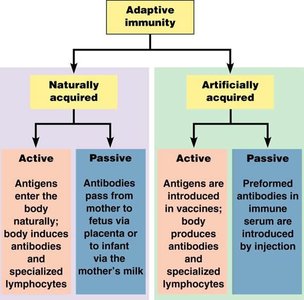
Dendritic Cells: Bridging Innate and Adaptive Immunity
Dendritic cells are professional antigen-presenting cells found in tissues. They capture antigens, migrate to lymph nodes, and initiate adaptive immune responses by presenting antigens to naïve lymphocytes. 
Organization of the Adaptive Immune Response
Adaptive immune responses are initiated in secondary lymphoid organs (lymph nodes, spleen, Peyer’s patches), where antigen-presenting cells stimulate naïve lymphocytes.
Antigen presentation: Dendritic cells present antigens to T and B cells.
Lymphocyte activation: Naïve lymphocytes are activated and proliferate.
Lymphocyte programming: Cells differentiate into effector or memory cells.
Antigenic Specificity
The high specificity of the adaptive immune system is due to antigen-specific receptors:
B cells: Immunoglobulins (antibodies)
T cells: T cell receptors (TCRs)
Each lymphocyte expresses a unique receptor, conferring one specificity per cell.
Clonal Selection Theory
Clonal selection is the process by which lymphocytes with receptors specific to an antigen are activated, proliferate, and differentiate into effector and memory cells.
Only a small number of lymphocytes are specific to any given antigen.
Upon antigen encounter, these cells expand and mount a targeted response.
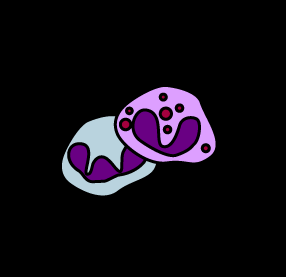
Effector Functions of T Cells
Helper T cells (CD4+): Direct immune responses, activate macrophages, stimulate B cells, and produce cytokines. Subtypes include Th1 (cell-mediated immunity), Th2 (humoral immunity), and Th17 (neutrophil responses).
Cytotoxic T cells (CD8+): Kill infected or abnormal cells via perforin-granzyme and CD95 pathways.
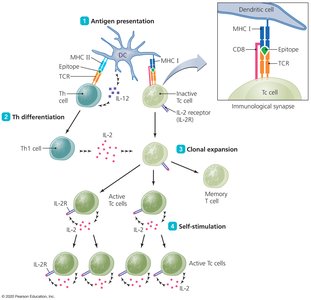
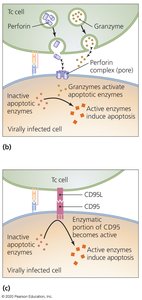
Effector Functions of B Cells and Antibodies
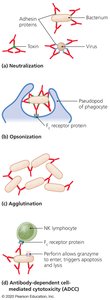
B cells differentiate into plasma cells that secrete antibodies. Antibodies bind to epitopes and function in:
Activation of complement and inflammation
Neutralization
Opsonization
Agglutination
Antibody-dependent cellular cytotoxicity (ADCC)
Classes of Antibodies
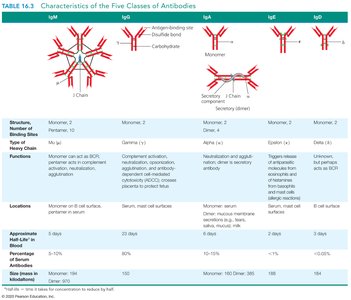
Antibodies are classified into five main types, each with distinct functions and properties.
Class | Structure | Function | Location |
|---|---|---|---|
IgG | Monomer | Complement activation, opsonization, neutralization | Blood, extracellular fluid |
IgM | Pentamer | First antibody produced, agglutination | Blood |
IgA | Dimer | Mucosal immunity | Mucous membranes, secretions |
IgE | Monomer | Allergic responses, defense against parasites | Bound to mast cells |
IgD | Monomer | B cell receptor | B cell surface |
T-Dependent Antibody Immunity
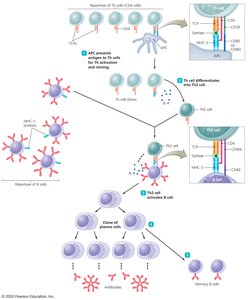
The induction of T-dependent antibody immunity involves four steps:
Antigen presentation for helper T cell activation and proliferation
Differentiation of helper T cells into Th2 cells
Activation of B cells
Proliferation and differentiation of B cells into plasma and memory cells
Immunological Memory
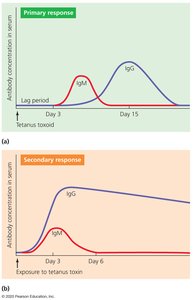
Memory cells are produced during the adaptive immune response and persist in lymphoid tissues.
Primary response: Slow, produces small amounts of antibodies.
Secondary response: Rapid and robust due to memory cells.

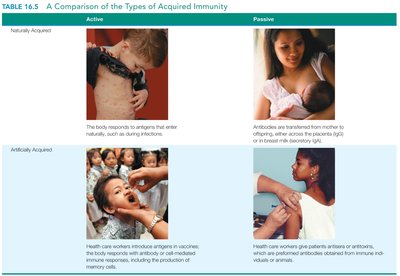
Types of Acquired Immunity
Acquired immunity can be classified as naturally or artificially acquired, and as active or passive.
Active | Passive | |
|---|---|---|
Naturally Acquired | Body responds to antigens during infection | Antibodies transferred from mother to offspring |
Artificially Acquired | Vaccination introduces antigens | Injection of preformed antibodies |
Immune Pathology and Autoimmunity
Immune pathology refers to tissue damage caused by immune responses, often seen in autoimmune diseases such as rheumatoid arthritis, lupus, and type I diabetes.
Immune responses may cause more harm than pathogens.
Autoimmune diseases result from loss of self-tolerance.
Summary Table: Adaptive Immune Response Steps
Step | Description |
|---|---|
Recognition | Detection of antigen by dendritic cells |
Alarm | Activation and migration of antigen-presenting cells |
Inflammation | Recruitment of immune cells to site of infection |
Innate cell recruitment | Mobilization of innate immune cells |
Innate effector function | Initial defense mechanisms |
Adaptive response | Activation, proliferation, and differentiation of lymphocytes |
Additional info: The adaptive immune system is essential for long-term protection and forms the basis for immunization strategies. Its dysfunction can lead to immunodeficiency or autoimmunity, highlighting the importance of specificity and regulation in immune responses.
