 Back
BackAdaptive Immunity: Cell-Mediated and Antibody Responses
Study Guide - Smart Notes
 Tailored notes based on your materials, expanded with key definitions, examples, and context.
Adaptive Immunity
Overview of Adaptive Immunity
Adaptive immunity is a highly specific defense mechanism that responds to intracellular pathogens and abnormal body cells, such as viruses, cancer cells, intracellular protozoa, and intracellular bacteria. It is characterized by its ability to recognize specific antigens and mount tailored responses.
Cell-mediated immune responses: Target infected or abnormal cells within the body.
Antibody immune responses: Target exogenous pathogens and toxins.
Cell-Mediated Immune Responses
Activation of Cytotoxic T Cell Clones and Their Functions
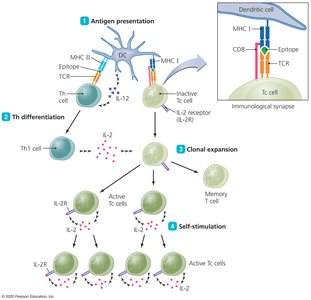
Cytotoxic T cells (Tc cells) are activated through a series of steps in lymphoid organs. These steps ensure that Tc cells are primed to recognize and destroy infected or abnormal cells.
Antigen presentation: Dendritic cells present antigens to inactive Tc cells via MHC I molecules.
Helper T cell differentiation: Helper T cells (Th cells) release cytokines that aid Tc cell activation.
Clonal expansion: Activated Tc cells proliferate, producing clones specific to the antigen.
Self-stimulation: Tc cells produce cytokines to sustain their own activation.
Mechanisms of Cytotoxic T Cell Killing
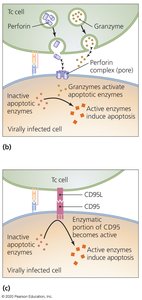
Cytotoxic T cells kill target cells through two primary pathways:
Perforin-granzyme pathway: Tc cells release perforin, forming pores in the target cell membrane, and granzyme, which enters the cell and induces apoptosis.
CD95 pathway: Tc cells express CD95 ligand, which binds to CD95 on target cells, triggering apoptosis via intracellular signaling.
Memory T Cells
Some activated T cells become memory T cells, which persist in lymphoid tissues for months or years. These cells are immediately functional upon subsequent contact with their specific antigen-MHC complex, providing a faster and more effective response than the primary activation.
Long-lived: Memory T cells can remain in the body for extended periods.
Rapid response: They respond quickly upon re-exposure to the antigen.
T Cell Regulation
Regulation of T cell activity is essential to prevent autoimmunity. T cells require additional signals from antigen-presenting cells (APCs) to become fully activated. Regulatory T cells moderate cytotoxic T cell activity, ensuring immune responses are controlled and do not target self-antigens.
Prevention of autoimmunity: Additional signals and regulatory T cells help maintain self-tolerance.
Antibody Immune Responses
Overview of Antibody Responses
Antibody immune responses are mounted against exogenous pathogens and toxins. These responses are highly specific and are activated only in response to particular pathogens.
Antibody production: B cells produce antibodies that neutralize pathogens and toxins.
Inducement of T-Dependent Antibody Immunity with Clonal Selection
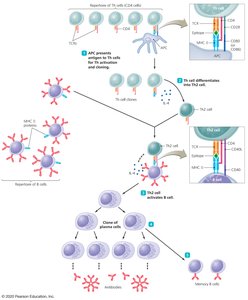
T-dependent antibody immunity relies on helper T cells and involves four main steps:
Antigen presentation for Th activation and proliferation: APCs present antigens to helper T cells.
Differentiation of helper T cells into Th2 cells: Th2 cells assist B cell activation.
Activation of B cells: B cells are activated by Th2 cells and antigen binding.
Proliferation and differentiation of B cells: B cells proliferate and differentiate into plasma cells and memory B cells.
Plasma Cells
Plasma cells are the majority of cells produced during B cell proliferation. They secrete antibody molecules complementary to the specific antigen and are short-lived, dying within a few days of activation. However, their antibodies and progeny can persist in the body.
Antibody secretion: Plasma cells produce large quantities of antibodies.
Short lifespan: Plasma cells are transient but their antibodies remain active.
Memory B Cells and Immunological Memory
Memory B cells are produced by B cell proliferation but do not secrete antibodies. They have B cell receptors (BCRs) complementary to the epitope that triggered their production and persist in lymphoid tissue. Upon re-exposure to the antigen, they initiate rapid antibody production.
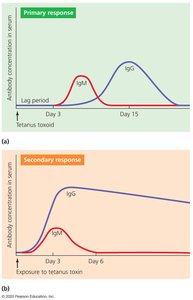
Primary immune response: Small amount of antibodies produced, takes days to reach effective levels.
Secondary immune response: Memory cells respond quickly, producing more antibodies in less time.
Types of Acquired Immunity
Overview of Acquired Immunity
Specific immunity can be acquired during an individual's life and is classified as either naturally or artificially acquired, and as active or passive.
Naturally acquired: Response against antigens encountered in daily life.
Artificially acquired: Response to antigens introduced via vaccination.
Active immunity: The body produces its own antibodies or immune cells.
Passive immunity: Antibodies are transferred from another source (e.g., mother to child).
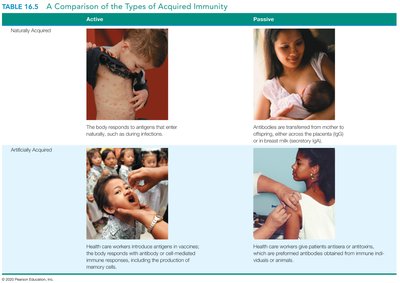
Type | Active | Passive |
|---|---|---|
Naturally Acquired | The body responds to antigens that enter naturally, such as during infections. | Antibodies are transferred from mother to child across the placenta (IgG) or in breast milk (secretory IgA). |
Artificially Acquired | Health care workers introduce antigens in vaccines; the body responds with antibody or cell-mediated immune responses, including the production of memory cells. | Health care workers give patients antisera or antitoxins, which are preformed antibodies obtained from immune individuals or animals. |
Key Concepts and Comparisons
Clonal Expansion
Clonal expansion is the process by which activated cytotoxic T cells and B cells proliferate to produce more cells specific to the antigen.
T cells: Clonal expansion results in memory T cells and cytotoxic T cells.
B cells: Clonal expansion results in memory B cells and plasma cells.
Memory T Cells vs. Cytotoxic T Cells
Memory T cells do not require interaction with antigen-presenting cells (APCs) to become activated, whereas cytotoxic T cells do.
Memory T cells: Rapidly respond upon re-exposure to antigen.
Cytotoxic T cells: Require APC interaction for initial activation.
Summary Table: Clonal Expansion Outcomes
Cell Type | Clonal Expansion Outcome |
|---|---|
B cells | Memory B cells and plasma cells |
T cells | Memory T cells and cytotoxic T cells |
Additional info:
Adaptive immunity is a central topic in microbiology, especially in understanding host-pathogen interactions and vaccine development.
Key terms: Antigen, Epitope, MHC (Major Histocompatibility Complex), TCR (T cell receptor), BCR (B cell receptor), Plasma cell, Memory cell, Clonal expansion, Perforin, Granzyme, CD95.
Equations: No specific equations, but immunological processes can be modeled mathematically in advanced studies.
----------------------------------------
