 Back
BackAdaptive Immunity: T Cells, B Cells, Antibodies, and Immunization
Study Guide - Smart Notes
 Tailored notes based on your materials, expanded with key definitions, examples, and context.
Adaptive Immune Responses
Overview of Adaptive Immunity
The adaptive immune system is characterized by its ability to specifically recognize and remember foreign antigens, providing long-lasting protection. It involves specialized lymphocytes—T cells and B cells—and the antibodies produced by B cells. Adaptive immunity is tightly regulated, highly specific, and capable of generating immunological memory.
Self-tolerance: The immune system distinguishes self from non-self, preventing attacks on the body's own tissues.
Specificity: Each lymphocyte or antibody recognizes a unique antigenic epitope.
Heterogeneity: The immune system can respond to a vast array of different antigens.
Memory: Upon re-exposure to the same antigen, the response is faster and stronger.
Regulation: Immune responses are tightly controlled to prevent overreaction.
Time to Develop: Adaptive responses typically take a week or more to fully develop after initial exposure.
Antigens and Lymphocytes
Antigens (Ags)
Antigens are molecules that elicit an immune response. Effective antigens are typically large, have a defined shape, and are chemically complex (often proteins or complex carbohydrates). The immune system recognizes specific regions called epitopes rather than the entire antigen molecule.
Lymphocytes: B Cells and T Cells
B lymphocytes (B cells): Develop in the bone marrow and mediate humoral immunity by secreting immunoglobulins (antibodies).
T lymphocytes (T cells): Develop in the thymus, possess T cell receptors (TCRs), and regulate immune responses or directly kill infected cells.
Lymphocyte Receptors and Antigen Recognition
Surface Receptors
T cell receptor (TCR): Recognizes processed antigen fragments presented by MHC molecules on other cells.
Immunoglobulin (Ig): Surface-bound on B cells; secreted as antibodies upon activation.
Each lymphocyte expresses a unique receptor that binds only one specific epitope. TCRs recognize antigens presented by MHC molecules, while B cell receptors recognize native antigens.
Major Histocompatibility Complex (MHC) and Antigen Presentation
MHC Class I and II
MHC molecules are essential for presenting antigenic peptides to T cells:
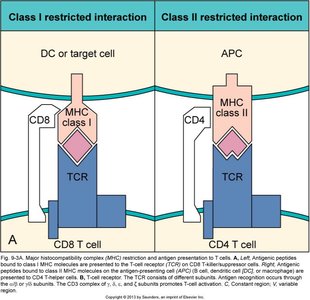
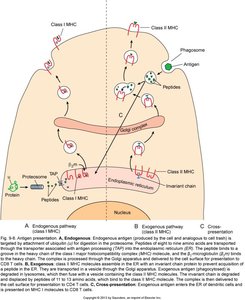
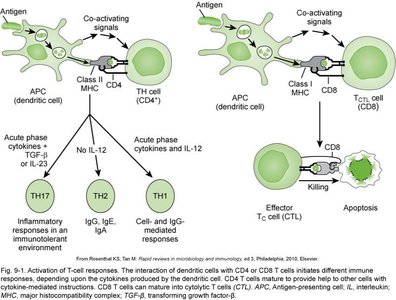
MHC Class I: Present on all nucleated cells; present endogenous antigens to CD8+ cytotoxic T cells.
MHC Class II: Present on antigen-presenting cells (APCs) such as dendritic cells, macrophages, and B cells; present exogenous antigens to CD4+ helper T cells.
T Cell Development and Diversity
TCR Gene Rearrangement
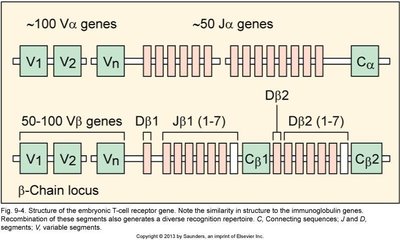
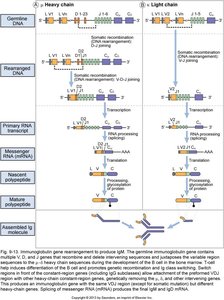
TCR diversity is generated through somatic recombination of variable (V), diversity (D), and joining (J) gene segments during T cell development. This process allows for an estimated 1018 different TCR specificities.
TCR Structure and Signaling
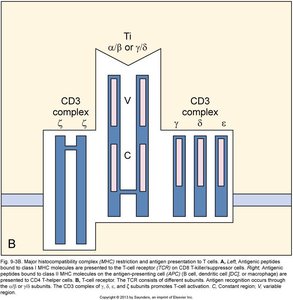
The TCR is composed of α and β chains (or γ and δ in some T cells), with variable regions that bind antigen-MHC complexes. The CD3 complex transduces activation signals into the T cell upon antigen recognition.
Types and Functions of T Cells
Helper T Cells (CD4+)
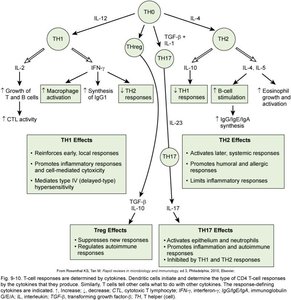
TH1: Produce IFN-γ, activate macrophages and cytotoxic T cells, promote cell-mediated immunity.
TH2: Produce IL-4, IL-5, activate B cells, promote humoral immunity and allergic responses.
TH17: Produce IL-17, recruit neutrophils, promote inflammation.
Treg: Produce IL-10, TGF-β, suppress immune responses to maintain tolerance.
Cytotoxic T Cells (CD8+)
Recognize antigen presented by MHC class I and kill infected or abnormal cells by releasing perforin and granzymes.
Superantigens
Mechanism and Effects
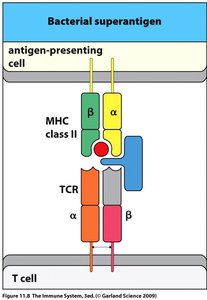
Superantigens are microbial proteins that non-specifically activate a large proportion of CD4+ T cells by bridging MHC class II and TCR outside the normal antigen-binding site. This leads to massive cytokine release, resulting in toxic shock and tissue damage.
B Cells and Antibody Production
Antibody Structure and Diversity
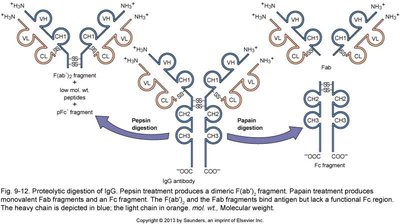
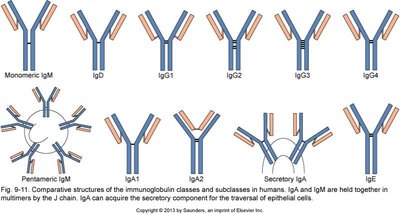
Antibodies (immunoglobulins) are Y-shaped proteins composed of two heavy and two light chains, each with variable regions for antigen binding. The diversity of antibodies is generated by V(D)J recombination, similar to TCRs.
Antibody Classes and Functions
IgM: First antibody produced; effective at activating complement.
IgG: Most abundant in blood; crosses placenta; good opsonin.
IgA: Protects mucosal surfaces; found in secretions.
IgE: Involved in allergy and defense against parasites.
IgD: Functions mainly as a B cell receptor.
Antibodies neutralize pathogens, opsonize for phagocytosis, activate complement, and mediate antibody-dependent cell-mediated cytotoxicity (ADCC).
Primary and Secondary Immune Responses
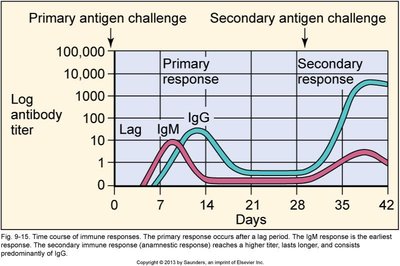
The primary response to an antigen is slower and dominated by IgM. Upon re-exposure, the secondary response is faster, stronger, and dominated by IgG due to immunological memory.
Antibody Functions
Neutralization: Block pathogen binding to host cells.
Opsonization: Enhance phagocytosis by marking pathogens for immune cells.
Complement Activation: Trigger the classical pathway of complement.
ADCC: Activate NK cells to kill antibody-coated target cells.
Mast Cell Activation: IgE binds to mast cells, triggering degranulation in allergic responses.
Categories of Acquired Immunity
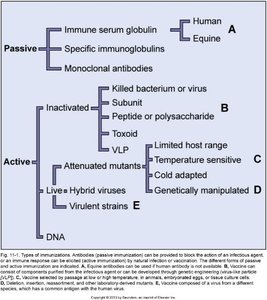
Passive Immunity
Transfer of pre-formed antibodies or immune cells.
Natural: Maternal IgG (placenta), IgA (breast milk).
Artificial: Administration of immune globulin, monoclonal antibodies, or immune cells.
Immediate but short-lived protection; does not generate memory.
Active Immunity
Development of an immune response after exposure to antigen.
Natural: Infection.
Artificial: Vaccination.
Long-lasting protection with immunological memory.
Immunization and Vaccines
Types of Vaccines
Inactivated (killed) vaccines: Organisms are killed but retain antigenicity; require boosters and adjuvants.
Live attenuated vaccines: Weakened organisms replicate in host; longer-lasting immunity but risk in immunocompromised individuals.
Subunit/acellular vaccines: Contain purified antigens (e.g., proteins, polysaccharides).
Toxoid vaccines: Inactivated toxins (e.g., diphtheria, tetanus).
Viral vector and RNA vaccines: Use genetic material to express antigens in host cells (e.g., some COVID-19 vaccines).
Herd Immunity
When a significant portion of a population is immune, the spread of infectious diseases is limited, protecting those who are not immune. However, herd immunity may not always prevent asymptomatic or mild infections.
Risks of Not Immunizing
Discontinuing vaccination leads to outbreaks of preventable diseases, resulting in significant morbidity and mortality, as evidenced by historical and recent epidemics.
Summary Table: Types of Immunity
Type | Source | Duration | Memory | Examples |
|---|---|---|---|---|
Passive | Pre-formed antibodies/cells | Short-term (weeks to months) | No | Maternal IgG, immune globulin |
Active | Own immune response | Long-term (years to lifetime) | Yes | Infection, vaccination |
Key Equations and Concepts
Antibody diversity: combinations (B cells), possible antibodies
TCR diversity: possible specificities
Additional info: The notes above integrate foundational immunology concepts with clinical relevance, including the importance of vaccination and herd immunity, and the molecular mechanisms underlying adaptive immune responses.
