Back
BackApplied and Industrial Microbiology: Food Preservation, Fermentation, and Industrial Applications
Study Guide - Smart Notes
 Tailored notes based on your materials, expanded with key definitions, examples, and context.
Applied and Industrial Microbiology
Introduction to Applied and Industrial Microbiology
Applied and industrial microbiology focuses on the use of microorganisms in the production and preservation of food, pharmaceuticals, and alternative energy sources. This field is essential for ensuring food safety, developing new biotechnological products, and advancing sustainable energy solutions.
Food Microbiology
Foods and Disease
Microorganisms play a dual role in food: they can cause spoilage and disease, but are also essential for the production of many fermented foods. Food safety is maintained through inspection and regulation by agencies such as the FDA and USDA. The Hazard Analysis and Critical Control Point (HACCP) system is used to identify and control points where contamination may occur.
Foodborne pathogens: Salmonella enterica serovars are frequent causes of foodborne illness.
Preservation methods: Additives (e.g., nisin), canning, drying, and refrigeration are used to prevent spoilage and pathogen growth.
Fermented Foods
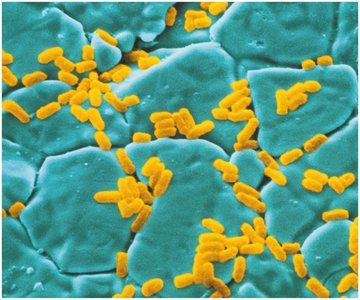
Fermentation is a metabolic process that converts sugars to acids, gases, or alcohol using microorganisms. It is widely used in the production of dairy, meat, fish, plant products, and breads.
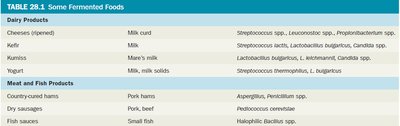
Product | Substrate | Microorganisms |
|---|---|---|
Cheeses (ripened) | Milk curd | Streptococcus spp., Lactococcus spp., Propionibacterium spp. |
Kefir | Milk | Streptococcus lactis, Lactobacillus delbrueckii, Candida spp. |
Kumiss | Mare's milk | Lactobacillus delbrueckii, L. acidophilus, Candida spp. |
Yogurt | Milk, milk solids | Streptococcus thermophilus, L. bulgaricus |
Country-cured hams | Pork hams | Aspergillus, Penicillium spp. |
Dry sausages | Pork, beef | Pediococcus cerevisiae |
Fish sauces | Small fish | Halophilic Bacillus spp. |
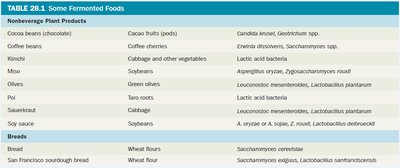
Product | Substrate | Microorganisms |
|---|---|---|
Cocoa beans (chocolate) | Cacao fruits (pods) | Candida krusei, Geotrichum spp. |
Coffee beans | Coffee cherries | Erwinia dissolvens, Saccharomyces spp. |
Kimchi | Cabbage and other vegetables | Lactic acid bacteria |
Miso | Soybeans | Aspergillus oryzae, Zygosaccharomyces rouxii |
Olives | Green olives | Leuconostoc mesenteroides, Lactobacillus plantarum |
Poi | Taro roots | Lactic acid bacteria |
Sauerkraut | Cabbage | Leuconostoc mesenteroides, Lactobacillus plantarum |
Soy sauce | Soybeans | A. oryzae or A. sojae, Z. rouxii, Lactobacillus delbrueckii |
Bread | Wheat flours | Saccharomyces cerevisiae |
San Francisco sourdough bread | Wheat flour | Saccharomyces exiguus, Lactobacillus sanfranciscensis |
Industrial Food Preservation
Industrial Food Canning
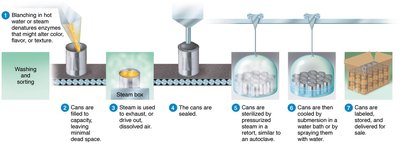
Canning is a critical method for preserving food by destroying microorganisms, especially endospore-forming bacteria such as Clostridium botulinum. The process involves commercial sterilization using steam under pressure in a retort, which is less rigorous than complete sterilization but sufficient for safety. The 12D treatment reduces the population of endospores by 12 logarithmic cycles, leaving only one survivor in 1012 endospores.
Thermophilic anaerobic spoilage: Caused by thermophilic bacteria in low-acid canned foods, resulting in gas production, lowered pH, and sour odor.
Flat sour spoilage: Thermophilic spoilage without gas, often due to Geobacillus stearothermophilus.
Mesophilic spoilage: Occurs in leaking cans due to external bacteria, causing putrefaction.
Acidic foods: Can be preserved at temperatures below 100°C; heat-resistant fungi such as Byssochlamys fulvus and Aspergillus may survive.
Can Construction
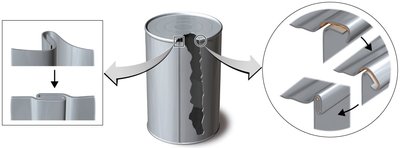
Metal cans are designed to prevent contamination and spoilage. The construction involves forming a side seam and a double seam for the top or bottom, which ensures a tight seal to keep out microorganisms.
Aseptic Packaging
Aseptic packaging allows for the use of materials that cannot tolerate heat, such as paper and plastic. These materials are sterilized using hot hydrogen peroxide, UV light, super-heated steam, or high-energy electron beams before being filled with sterile food products.
Radiation and Industrial Food Preservation
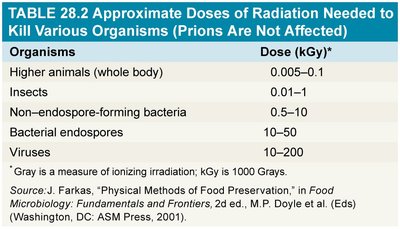
Radiation is used to preserve food by killing microorganisms. The effectiveness depends on the dose, measured in kilograys (kGy):
Low doses (<1 kGy): Kill insects and inhibit sprouting.
Pasteurizing doses (1–10 kGy): Reduce pathogens on meat and poultry.
High doses (>10 kGy): Sterilize or greatly reduce bacteria in spices.
Organisms | Dose (kGy) |
|---|---|
Higher animals (whole body) | 0.005–0.1 |
Insects | 0.01–1 |
Non–endospore-forming bacteria | 0.5–10 |
Bacterial endospores | 10–50 |
Viruses | 10–200 |
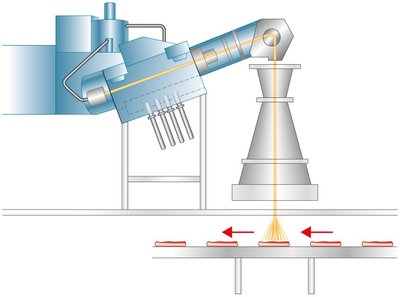
Gamma rays (from cobalt-60) and high-energy electron accelerators are used for deep penetration and rapid sterilization, respectively.

High-Pressure Food Preservation (Pascalization)
Pascalization involves submerging prewrapped, precooked foods into pressurized water tanks (up to 87,000 psi). This process kills many pathogens and nonpathogens while preserving food color and flavor.
Microbial Fermentation in Food Production
Cheese Production
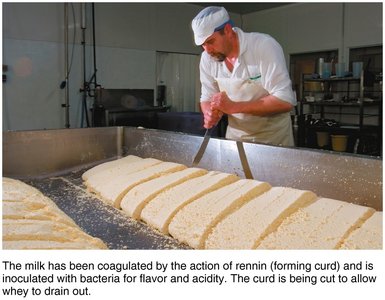
Cheese is produced by coagulating milk with the enzyme rennin and lactic acid bacteria, forming curd. The liquid whey is separated from the curd. Hard cheeses are ripened by lactic acid bacteria (e.g., Propionibacterium in Swiss cheese), while soft cheeses are ripened by Penicillium on the surface.
Other Dairy Products
Butter: Flavor and aroma are due to diacetyls produced by lactic acid bacteria.
Yogurt: Produced by inoculating milk with Streptococcus thermophilus and Lactobacillus delbrueckii bulgaricus.
Kefir and Kumiss: Fermented milk beverages made with lactic acid–producing bacteria and lactose-fermenting yeast.
Nondairy Fermentations
Bread dough and beer: Saccharomyces cerevisiae produces ethanol anaerobically.
Other fermented foods: Sauerkraut, pickles, olives, chocolate, and coffee are produced using various bacteria and fungi.
Alcoholic Beverages and Vinegar
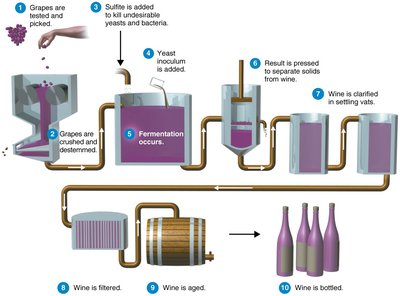
Alcoholic beverages are produced by fermenting plant sugars or grain starches. Beer and ale are made from grains, sake from rice (using Aspergillus), and wine from grapes. Malolactic fermentation by bacteria reduces wine acidity. Vinegar is produced by aerobic conversion of ethanol to acetic acid by Acetobacter and Gluconobacter.
Industrial Microbiology and Biotechnology
Bioreactors and Large-Scale Fermentation
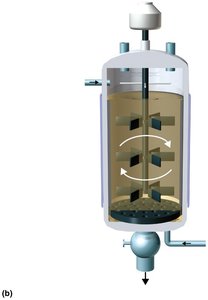
Bioreactors are used for the large-scale growth of microorganisms to produce industrial products such as solvents, antibiotics, and enzymes. These vessels maintain optimal conditions for microbial growth and product formation.
Industrial Products from Microbes
Xanthan gum: Produced by Xanthomonas campestris using lactose from whey. Used as a thickener in foods and cosmetics.
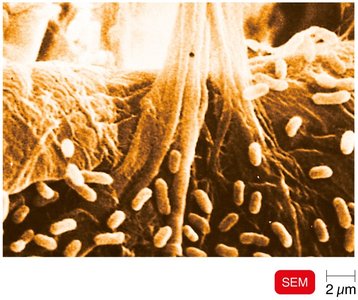
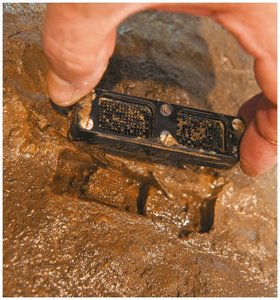
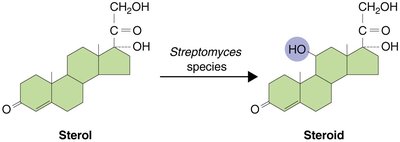
Pharmaceuticals: Antibiotics (e.g., from Streptomycetes), vaccines, and steroids are produced using microbial fermentation. The iChip allows for the discovery of new antibiotics by growing bacteria in their natural environment.
Microbes and Alternative Energy
Biomass and Bioconversion
Biomass refers to organic matter produced by living organisms. Bioconversion is the process of converting biomass into alternative energy sources, such as methane and ethanol, using microbial metabolism.
Biofuels
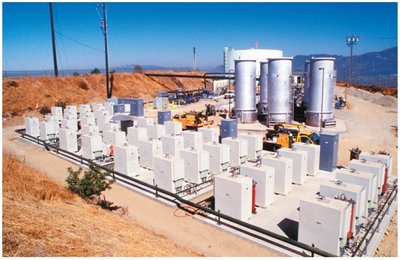
Biofuels are produced from living organisms. Microorganisms ferment sugars to ethanol, digest cellulose to produce ethanol, and algae can yield oil and ethanol. Methane is produced from waste in landfills and can be used to generate electricity.
Exploring the Microbiome: Microbial Control of Disease Vectors
Using Bacteria to Stop the Spread of Zika Virus
Microbiome research includes using bacteria such as Wolbachia to control the spread of vector-borne diseases like Zika virus. Wolbachia can infect insect vectors and reduce their ability to transmit pathogens.