 Back
BackBiosynthesis and Metabolic Pathways in Microorganisms
Study Guide - Smart Notes
 Tailored notes based on your materials, expanded with key definitions, examples, and context.
Biosynthesis and Metabolism Overview
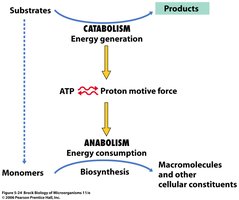
Catabolism and Anabolism
Microbial metabolism is divided into two major processes: catabolism (energy generation) and anabolism (biosynthesis). Catabolism breaks down substrates to generate ATP and proton motive force, while anabolism uses this energy to synthesize macromolecules from monomers.
Catabolism: Degradation of substrates to produce energy (ATP, proton motive force).
Anabolism: Consumption of energy to build cellular components such as proteins, nucleic acids, and polysaccharides.
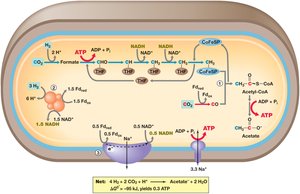
Acetogenesis in Acetobacterium woodii
Reactions of Acetogenesis from H2 and CO2
Acetogenesis is a process by which certain bacteria, such as Acetobacterium woodii, convert H2 and CO2 into acetate. This pathway is important for energy conservation and carbon fixation in anaerobic environments.
Key Steps: Reduction of CO2 to formate, then to acetyl-CoA, and finally to acetate.
Energy Conservation: ATP is generated via substrate-level phosphorylation and sodium ion gradients.
Net Reaction: 4 H2 + 2 CO2 → Acetate + 2 H2O
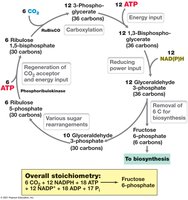
The Calvin-Benson Cycle
CO2 Fixation in Autotrophic Microorganisms
The Calvin-Benson cycle is the primary pathway for carbon fixation in autotrophic bacteria and plants. It incorporates CO2 into organic molecules using ATP and NADPH generated from light or chemical energy.
Phases: Carboxylation, reduction, and regeneration of ribulose-1,5-bisphosphate.
Key Enzyme: Ribulose-1,5-bisphosphate carboxylase/oxygenase (RuBisCO).
Overall Stoichiometry: 6 CO2 + 12 NADPH + 18 ATP + 12 H2O → Fructose-6-phosphate + 12 NADP+ + 18 ADP + 17 Pi
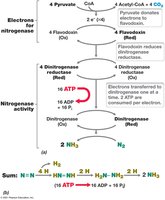
Biological Nitrogen Fixation
Nitrogenase Enzyme Complex
Nitrogen fixation is the reduction of atmospheric nitrogen (N2) to ammonia (NH3) by the enzyme nitrogenase. This process is essential for incorporating nitrogen into biological molecules.
Electron Donors: Pyruvate and reduced ferredoxin provide electrons for nitrogenase.
ATP Requirement: The process is energy-intensive, requiring 16 ATP per N2 reduced.
Products: 2 NH3 and H2 per N2 molecule fixed.
Biosynthesis of Sugars and Polysaccharides
Hexose and Pentose Formation
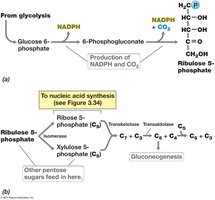
Microorganisms synthesize hexoses (e.g., glucose) and pentoses (e.g., ribose) for use in energy storage and nucleic acid synthesis. Hexoses can be obtained from the environment or synthesized via gluconeogenesis, while pentoses are produced by decarboxylation of hexoses through the pentose phosphate pathway.
Hexose Synthesis: Involves reversal of glycolysis and gluconeogenesis.
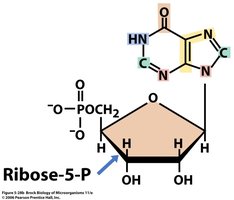
Pentose Synthesis: Utilizes the pentose phosphate pathway to generate ribose-5-phosphate for nucleotide biosynthesis.
Polysaccharide Biosynthesis
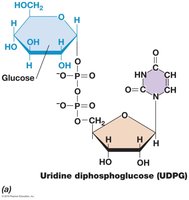
Polysaccharides such as glycogen, starch, and peptidoglycan subunits are synthesized from activated glucose derivatives, including ADP-glucose (ADPG) and UDP-glucose (UDPG).
Activation: Glucose is activated by attachment to nucleotides (ADP or UDP).
Polymerization: Activated glucose is added to growing polysaccharide chains.

Biosynthesis of Amino Acids
Carbon Skeletons and Amino Group Incorporation
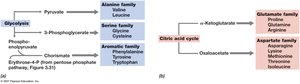
Amino acids are synthesized from intermediates of glycolysis and the citric acid cycle. The amino group is typically derived from inorganic nitrogen sources such as ammonia (NH3).
Families: Amino acids are grouped based on their precursor molecules (e.g., pyruvate, oxaloacetate, α-ketoglutarate).
Transamination: Amino groups are transferred to carbon skeletons to form amino acids.
Ammonia Incorporation in Bacteria
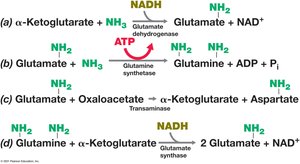
Bacteria assimilate ammonia via two main pathways: the glutamate dehydrogenase pathway and the glutamine synthetase–glutamate synthase pathway.
Glutamate Dehydrogenase: Incorporates NH3 into α-ketoglutarate to form glutamate.
Glutamine Synthetase: Converts glutamate and NH3 to glutamine (requires ATP).
Glutamate Synthase: Transfers the amide group from glutamine to α-ketoglutarate, forming two glutamate molecules.
Citric Acid Cycle in Biosynthesis
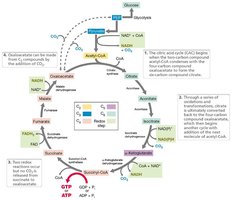
The citric acid cycle (TCA cycle) provides key intermediates for the biosynthesis of amino acids and other cellular components. Oxaloacetate and α-ketoglutarate are important precursors for aspartate and glutamate families of amino acids, respectively.
Amphibolic Role: The TCA cycle functions in both energy production and biosynthesis.
Precursor Supply: Intermediates are withdrawn for anabolic reactions and replenished by anaplerotic reactions.
Biosynthesis of Nucleotides
Purine and Pyrimidine Synthesis
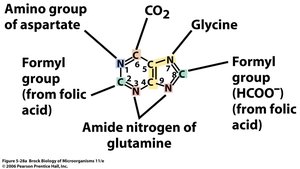
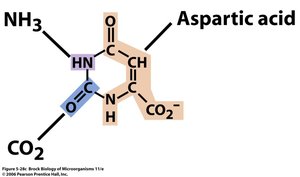
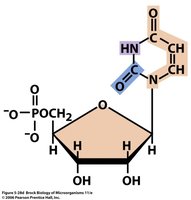
Nucleotide biosynthesis involves the assembly of carbon and nitrogen atoms from various sources. Purines (adenine, guanine) are synthesized from inosinic acid, while pyrimidines (cytosine, thymine, uracil) are synthesized from uridylate.
Precursors: Carbon from CO2, glycine, and formyl groups; nitrogen from aspartate and glutamine.
Key Intermediates: Inosinic acid (purines), uridylate (pyrimidines).
Biosynthesis of Fatty Acids and Lipids
Fatty Acid Synthesis
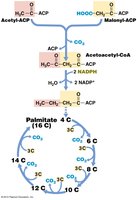
Fatty acids are synthesized by the sequential addition of two-carbon units (acetyl groups) carried by acyl carrier protein (ACP). The process involves repeated cycles of condensation, reduction, dehydration, and reduction, using NADPH as a reducing agent.
Initiation: Acetyl-ACP and malonyl-ACP are the starting substrates.
Elongation: Two-carbon units are added per cycle to form long-chain fatty acids (e.g., palmitate, C16).
Lipid Assembly: Fatty acids are combined with glycerol, phosphate, and sugars to form complex lipids.
Summary Table: Key Biosynthetic Pathways
Pathway | Main Products | Key Precursors | Energy Requirement |
|---|---|---|---|
Calvin-Benson Cycle | Hexose sugars | CO2, ATP, NADPH | High (18 ATP, 12 NADPH per 1 hexose) |
Pentose Phosphate Pathway | Pentoses, NADPH | Glucose-6-phosphate | Low |
Nitrogen Fixation | NH3 | N2, electrons, ATP | Very high (16 ATP per N2) |
Amino Acid Synthesis | Amino acids | Glycolysis/TCA intermediates, NH3 | Variable |
Nucleotide Synthesis | Purines, pyrimidines | Ribose-5-phosphate, amino acids | Moderate |
Fatty Acid Synthesis | Fatty acids | Acetyl-CoA, NADPH | High |
