 Back
BackCell Structure and Function in Microbiology Ch3-2
Study Guide - Smart Notes
 Tailored notes based on your materials, expanded with key definitions, examples, and context.
Cell Structure and Function
Introduction
This chapter explores the structural and functional organization of prokaryotic and eukaryotic cells, focusing on the cytoplasmic membrane, transport mechanisms, cytoplasmic components, and the unique features of bacteria, archaea, and eukaryotes. Understanding these cellular structures is fundamental to microbiology, as they underpin microbial physiology, adaptation, and survival.
Bacterial Cytoplasmic Membranes
Active Transport and Group Translocation
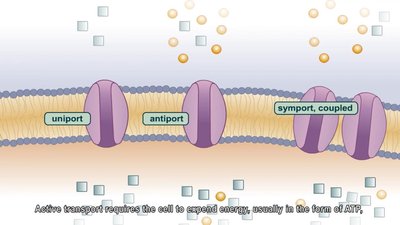
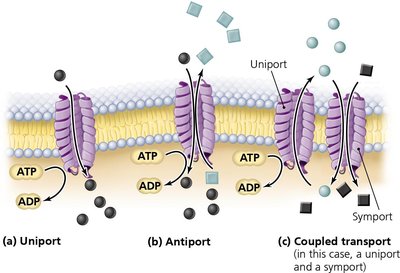
The bacterial cytoplasmic membrane is essential for controlling the movement of substances into and out of the cell. It utilizes both passive and active transport mechanisms:
Active Transport: Requires energy (usually ATP) to move substances against their electrochemical gradient. Types include unipport, antiport, and symport systems.
Group Translocation: A unique form of active transport where the substance is chemically modified during its passage across the membrane (e.g., phosphorylation of glucose).
Types of Transport Processes
Transport across bacterial membranes can be classified as passive or active:
Passive Transport: Does not require cellular energy. Includes diffusion, facilitated diffusion, and osmosis.
Active Transport: Requires ATP to move substances against their gradient.
Group Translocation: Substance is chemically altered during transport (e.g., glucose to glucose-6-phosphate).
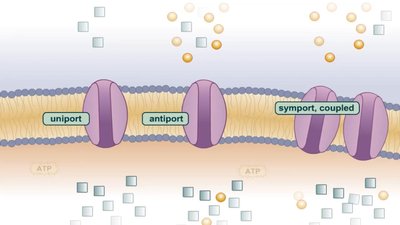
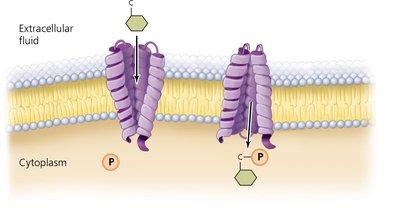
Table: Transport Processes Across Bacterial Cytoplasmic Membranes
Process | Description | Examples of Transported Substances |
|---|---|---|
Diffusion | Molecules move down their electrochemical gradient through the phospholipid bilayer. | O2, CO2, lipid-soluble chemicals |
Facilitated diffusion | Molecules move down their gradient through channels or carrier proteins. | Glucose, fructose, urea, some vitamins |
Osmosis | Water moves down its concentration gradient across a selectively permeable membrane. | Water |
Active transport | ATP-dependent carrier proteins bring substances into the cell. | Na+, K+, Ca2+, H+, Cl− |
Group translocation | Substance is chemically altered during transport. | Glucose, mannose, fructose |
Cytoplasm of Bacteria
Cytosol and Inclusions
The cytosol is the liquid portion of the cytoplasm, primarily composed of water and containing the cell's DNA in the nucleoid region. Inclusions are reserve deposits of chemicals, such as polyhydroxybutyrate (PHB) granules, which serve as energy and carbon storage.

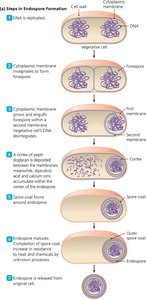
Endospores
Endospores are highly resistant, dormant structures formed by some bacteria (e.g., Bacillus and Clostridium) as a defense against unfavorable conditions. They are resistant to heat, radiation, and chemicals, allowing survival in extreme environments.
Formation: Vegetative cells transform into endospores when nutrients are limited.
Significance: Endospores can remain viable for decades and are a concern in medical and food industries due to their resilience.

Cytoplasm of Prokaryotes
Nonmembranous Organelles
Ribosomes: Sites of protein synthesis, composed of polypeptides and rRNA. Prokaryotic ribosomes are 70S (smaller than eukaryotic 80S ribosomes).
Cytoskeleton: Composed of protein fibers, involved in cell division, maintaining cell shape, DNA segregation, and movement.

External Structures of Archaea
Glycocalyces, Flagella, Fimbriae, and Hami
Glycocalyces: Aid in biofilm formation and cell adhesion.
Flagella: Structurally distinct from bacterial flagella; used for motility.
Fimbriae and Hami: Fimbriae are used for attachment; hami are unique, hook-like structures for surface attachment.

Archaeal Cell Walls and Cytoplasmic Membranes
Structure and Function
Most archaea have cell walls composed of specialized polysaccharides and proteins (not peptidoglycan).
All archaea have cytoplasmic membranes that maintain gradients and regulate transport.

Cytoplasm of Archaea
Similarities and Differences with Bacteria
Both have 70S ribosomes, fibrous cytoskeleton, and circular DNA.
Archaea differ in ribosomal proteins, metabolic enzymes, and genetic code (more similar to eukaryotes).
Table: Some Structural Characteristics of Prokaryotes
Feature | Archaea | Bacteria |
|---|---|---|
Glycocalyx | Polypeptide or polysaccharide | Polypeptide or polysaccharide |
Flagella | Present in some; 10–14 nm diameter; grow at base | Present in some; ~20 nm diameter; grow at tip |
Fimbriae | Proteinaceous; attachment, biofilms | Proteinaceous; attachment, motility, biofilms |
Pili | None discovered | Present in some; DNA exchange |
Hami | Present in some; attachment | Absent |
Cell Walls | Polysaccharides/proteins (no peptidoglycan) | Peptidoglycan |
Cytoplasmic Membrane | Ether-linked lipids; some single layer | Ester-linked phospholipid bilayer |
Cytoplasm | Circular DNA, 70S ribosomes (eukaryote-like proteins) | Circular DNA, 70S ribosomes (bacterial proteins) |
External Structure of Eukaryotic Cells
Glycocalyces
Less organized than prokaryotic capsules.
Functions: anchor cells, strengthen surfaces, prevent dehydration, and mediate cell recognition and communication.
Eukaryotic Cell Walls and Cytoplasmic Membranes
Cell Walls
Present in fungi, algae, plants, and some protozoa.
Composed of cellulose (plants), chitin/glucomannan (fungi), or various polysaccharides (algae).

Cytoplasmic Membranes
Fluid mosaic of phospholipids and proteins.
Contain steroid lipids for fluidity and membrane rafts for specialized functions.
Control movement of substances into and out of the cell.

Endocytosis and Exocytosis
Endocytosis: Uptake of substances via phagocytosis (solids) or pinocytosis (liquids) using pseudopods.
Exocytosis: Release of substances by fusion of vesicles with the membrane.
Table: Active Transport Processes Found Only in Eukaryotes
Process | Description | Examples |
|---|---|---|
Endocytosis | Substances surrounded by pseudopods and brought into cell | Bacteria, viruses, dead cells, liquid nutrients |
Exocytosis | Vesicles fuse with membrane, releasing contents | Wastes, secretions |
Cytoplasm of Eukaryotes
Flagella and Cilia
Flagella: Differ structurally from prokaryotic flagella; composed of microtubules in a "9+2" arrangement, anchored by a basal body, and move by undulation.
Cilia: Shorter, more numerous, and beat in coordinated waves to move cells or substances.

Other Nonmembranous Organelles
Ribosomes: Larger (80S) than prokaryotic ribosomes, composed of 60S and 40S subunits.
Cytoskeleton: Network of microtubules, microfilaments, and intermediate filaments for shape, support, and movement.
Centrioles and Centrosome: Involved in mitosis, cytokinesis, and formation of flagella/cilia (not present in all eukaryotes).
Membranous Organelles
Nucleus: Contains most DNA, surrounded by a nuclear envelope with pores; nucleolus synthesizes RNA.
Endoplasmic Reticulum (ER): Network for transport and synthesis; rough ER (with ribosomes) and smooth ER (lipid synthesis).
Golgi Body: Processes and packages molecules for export.
Lysosomes, Peroxisomes, Vacuoles, Vesicles: Storage, digestion, and detoxification.
Mitochondria: Double-membraned, produce ATP, contain their own DNA and 70S ribosomes.
Chloroplasts: Found in photosynthetic eukaryotes, site of photosynthesis, contain DNA and 70S ribosomes.
Table: Nonmembranous and Membranous Organelles of Cells
Organelle | General Function | Prokaryotes | Eukaryotes |
|---|---|---|---|
Ribosomes | Protein synthesis | Present in all | Present in all |
Cytoskeleton | Shape, support, movement | Some | All |
Centrosome | Mitosis, cytokinesis, flagella/cilia formation | Absent | Animals |
Nucleus | Control center | Absent | All |
ER | Transport, lipid synthesis | Absent | All |
Golgi bodies | Secretion | Absent | Some |
Lysosomes | Breakdown, self-destruction | Absent | Some |
Peroxisomes | Neutralize toxins | Absent | Some |
Vacuoles/Vesicles | Storage, digestion, transport | Absent | Some/All |
Mitochondria | ATP production | Absent | Most |
Chloroplasts | Photosynthesis | Absent | Plants, algae |
Comparison of Archaeal, Bacterial, and Eukaryotic Cells
Key Differences
Characteristic | Archaea | Bacteria | Eukaryotes |
|---|---|---|---|
Nucleus | Absent | Absent | Present |
Organelles | Absent | Few | Various types present |
Glycocalyx | Present | Present | Some |
Motility | Some | Some | Some |
Flagella | Some; rotate | Some; rotate | Some; undulate |
Cilia | Absent | Absent | Some |
Fimbriae/Pili | Some | Some | Absent |
Hami | Some | Absent | Absent |
Cell Wall | Most; no peptidoglycan | Most; peptidoglycan | Plants, algae, fungi |
Cytoplasmic Membrane | All | All | All |
Cytosol | All | All | All |
Inclusions | Most | Most | Some |
Endospores | Absent | Some | Absent |
Ribosomes | 70S | 70S | 80S (cytosol/ER), 70S (mitochondria/chloroplasts) |
Chromosomes | Single, circular | Single, circular | Linear, multiple |
Endosymbiotic Theory
The endosymbiotic theory proposes that eukaryotic cells originated from a symbiotic relationship between small aerobic prokaryotes (which became mitochondria) and larger anaerobic prokaryotes. Chloroplasts are thought to have a similar origin in photosynthetic eukaryotes.
Summary
Understanding the structural and functional differences among bacteria, archaea, and eukaryotes is crucial for microbiology. These differences impact microbial physiology, adaptation, and the development of antimicrobial strategies.
