 Back
BackChapter 16: Adaptive Immunity – Study Notes
Study Guide - Smart Notes
 Tailored notes based on your materials, expanded with key definitions, examples, and context.
Adaptive Immunity
Overview of Adaptive Immunity
Adaptive immunity is the specialized branch of the immune system that provides a targeted, learned defense against specific pathogens. It is characterized by its ability to recognize and remember specific antigens, leading to a more effective response upon subsequent exposures.
Antibody (humoral) immune responses: Mediated by B lymphocytes and antibodies targeting extracellular pathogens.
Cell-mediated immune responses: Mediated by T lymphocytes targeting infected or abnormal cells.
Key Features of Adaptive Immunity:
Specificity: Recognizes and responds to unique antigens.
Inducibility: Activated only upon exposure to specific antigens.
Clonality: Activated lymphocytes proliferate to form clones targeting the same antigen.
Unresponsiveness to self: Self-reactive cells are eliminated to prevent autoimmunity.
Memory: Memory cells ensure a faster, stronger response upon re-exposure to the same antigen.
Lymphatic System and Organs
Structure and Function
The lymphatic system is a network of vessels, organs, and tissues essential for fluid balance and immune defense. It returns interstitial fluid to the bloodstream, filters lymph for pathogens, and houses immune cells.
Primary lymphoid organs: Sites of lymphocyte formation and maturation.
Red bone marrow: Formation of all blood cells; B cells mature here.
Thymus: T cells mature and learn self-tolerance; largest during childhood.
Secondary lymphoid organs: Sites where lymphocytes encounter antigens.
Lymph nodes
Spleen
Tonsils
Lymphocytes and Their Roles
B Lymphocytes (B cells)
Mature in red bone marrow.
Responsible for humoral immunity by producing antibodies.
Differentiation into plasma cells, which secrete antibodies.
T Lymphocytes (T cells)
Mature in the thymus.
Responsible for cell-mediated immunity.
Handle a variety of immune functions, including killing infected cells and regulating immune responses.
Antibodies (Immunoglobulins)
Functions of Antibodies
Neutralization: Bind to pathogens or toxins, blocking their entry into cells.
Opsonization: Coat pathogens, enhancing phagocytosis by immune cells.
Agglutination: Bind multiple pathogens, causing clumping for easier removal.
Antibody-Dependent Cellular Cytotoxicity (ADCC): Tag infected or abnormal cells for destruction by NK cells.
Five Classes of Antibodies
IgM: First antibody produced; excellent at activating complement and agglutination.
IgG: Most common in blood; crosses placenta; long-term immunity; effective in neutralization, opsonization, and complement activation.
IgA: Found in mucosal secretions; protects mucosal surfaces.
IgE: Involved in allergic reactions and defense against parasitic worms; triggers histamine release.
IgD: Found on B cell surfaces; helps activate B cells; function not fully understood.
Major Histocompatibility Complex (MHC)
Structure and Function
The MHC is a group of glycoproteins on cell surfaces that help the immune system distinguish self from non-self. They are crucial for antigen presentation and tissue compatibility in transplantation.
MHC I: Present on all nucleated cells; displays endogenous antigens; recognized by cytotoxic T cells (CD8+).
MHC II: Present only on professional antigen-presenting cells (APCs); displays exogenous antigens; recognized by helper T cells (CD4+).
Antigen-Presenting Cells (APCs)
Role in Adaptive Immunity
APCs ingest pathogens, process them, and present antigen fragments on MHC II molecules.
Major APCs: dendritic cells (most important), macrophages, and B cells.
APCs activate helper T cells (CD4+), initiating adaptive immune responses.
Antigens
Types of Antigens
Exogenous antigens: Enter the body from the environment (e.g., bacteria, toxins).
Endogenous antigens: Generated within cells (e.g., viral proteins).
Autoantigens: Derived from normal cellular processes; usually ignored by the immune system.
Types of T Lymphocytes
Classification and Functions
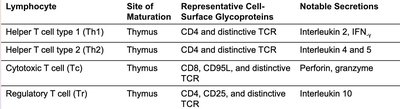
T lymphocytes are classified based on their surface markers and functions. The main types include helper T cells (Th1 and Th2), cytotoxic T cells (Tc), and regulatory T cells (Tr).
Lymphocyte | Site of Maturation | Representative Cell-Surface Glycoproteins | Notable Secretions |
|---|---|---|---|
Helper T cell type 1 (Th1) | Thymus | CD4 and distinctive TCR | Interleukin 2, IFN-γ |
Helper T cell type 2 (Th2) | Thymus | CD4 and distinctive TCR | Interleukin 4 and 5 |
Cytotoxic T cell (Tc) | Thymus | CD8, CD95L, and distinctive TCR | Perforin, granzyme |
Regulatory T cell (Tr) | Thymus | CD4, CD25, and distinctive TCR | Interleukin 10 |
Clonal Deletion of T Cells
Mechanism and Importance
Clonal deletion is a quality-control process in the thymus that ensures T cells do not attack the body’s own tissues. Developing T cells are tested for their ability to recognize MHC and avoid strong recognition of self-antigens. Cells failing these tests undergo apoptosis, while some become regulatory T cells to suppress autoimmunity.
T cells that do not recognize MHC or strongly recognize self-antigens are eliminated.
Some self-reactive T cells become regulatory T cells (Tregs) to prevent autoimmune reactions.
T cells that recognize MHC and foreign epitopes survive and form the functional T cell repertoire.
Types of Immunity
Acquisition of Immunity
Naturally acquired active immunity: Long-lasting; results from infection and antibody production by the host (e.g., recovering from illness).
Naturally acquired passive immunity: Immediate, temporary; transfer of antibodies from mother to child (e.g., via breast milk).
Artificially acquired active immunity: Long-lasting; results from vaccination, stimulating the host’s own antibody production.
Artificially acquired passive immunity: Immediate, short-term; injection of pre-made antibodies (e.g., gamma globulins, antivenoms).
