 Back
BackChapter 2: The Chemistry of Microbiology – Structured Study Notes Ch2-2
Study Guide - Smart Notes
 Tailored notes based on your materials, expanded with key definitions, examples, and context.
Chapter 2: The Chemistry of Microbiology
Chemical Reactions in Microbiology
Chemical reactions are fundamental to the biochemistry of living organisms, including microbes. These reactions involve the making or breaking of chemical bonds and are essential for cellular processes.
Reactants and Products: Reactants are substances that undergo change, while products are the result of the reaction.
Biochemistry: The study of chemical reactions in living things.
Synthesis Reactions
Synthesis reactions form larger, more complex molecules from smaller ones. These reactions require energy and are often endothermic.
Dehydration Synthesis: A common synthesis reaction where water is formed as a byproduct.
Anabolism: All synthesis reactions in an organism.
Example: Formation of proteins from amino acids.

Decomposition Reactions
Decomposition reactions break bonds within larger molecules to form smaller atoms, ions, and molecules. These reactions release energy and are often exothermic.
Hydrolysis: A common decomposition reaction where water is used to break bonds.
Catabolism: All decomposition reactions in an organism.
Example: Breakdown of starch into glucose.

Exchange Reactions
Exchange reactions involve both breaking and forming covalent bonds, with atoms moving from one molecule to another. These reactions have both endothermic and exothermic steps.
Metabolism: The sum of all chemical reactions in an organism.
Water, Acids, Bases, and Salts
Water
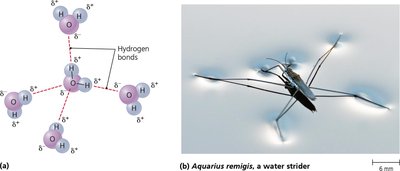
Water is the most abundant substance in organisms and has unique properties due to its polar covalent bonds.
Cohesive Molecules: Water molecules stick together, generating surface tension.
Solvent: Water dissolves many substances, facilitating biochemical reactions.
Thermal Stability: Water absorbs heat without significant temperature change.
Participation in Reactions: Water is involved in many chemical reactions.
Acids and Bases
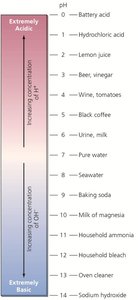
Acids and bases are dissociated by water into component ions. The concentration of hydrogen ions (H+) is measured using the pH scale.
Acid: Dissociates into one or more H+ and one or more anions.
Base: Binds with H+ or dissociates into cations and OH−.
pH Scale: Measures the concentration of H+ in solution.

Acid-Base Balance and Buffers
Metabolism requires a constant balance of acids and bases. Buffers help prevent drastic changes in internal pH.
Microbial Tolerance: Most microbes grow best between pH 6.5 and 8.5.
Environmental Impact: Microorganisms can alter the pH of their environment.
Salts
Salts dissociate in water into cations and anions other than H+ and OH−. These ions are electrolytes essential for cellular functions.
Electrolytes: Create electrical differences, transfer electrons, and form enzyme components.
Organic Macromolecules
Functional Groups
Organic molecules contain carbon and hydrogen atoms, often arranged in functional groups. Macromolecules are large molecules used by all organisms, built from monomers.
Types of Macromolecules: Lipids, carbohydrates, proteins, nucleic acids.
Monomers: Basic building blocks of macromolecules.
Structure | Name | Class of Compounds |
|---|---|---|
Single bond O H | Hydroxyl | Alcohol, Monosaccharide, Amino acid |
R-O-R' | Ether | Disaccharide, Polysaccharide |
R-CO-R' | Ketone | Carbohydrate |
R-CO-H | Aldehyde | Carbohydrate |
R-COOH | Carboxyl | Amino acid, Protein, Fatty acid |
R-NH2 | Amino | Amino acid, Protein |
R-CO-O-R' | Ester | Fat, Wax |
R-CH2-SH | Sulfhydryl | Amino acid, Protein |
R-CH2-O-PO4 | Organic phosphate | Phospholipid, Nucleotide, ATP |

Lipids
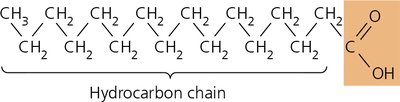
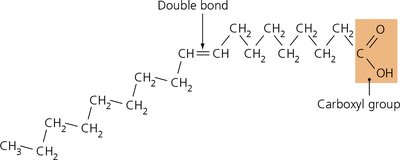
Lipids are hydrophobic molecules not composed of regular subunits. They are essential for cell structure and energy storage.
Types: Fats (triglycerides), phospholipids, waxes, steroids.

Carbon Atoms: Double Bonds | Type | Structure | Common Name | Melting Point |
|---|---|---|---|---|
16:0 | Saturated | CH3-(CH2)14-COOH | Palmitic acid | 63°C |
18:0 | Saturated | CH3-(CH2)16-COOH | Stearic acid | 70°C |
18:1 | Monounsaturated | CH3-(CH2)7-CH=CH-(CH2)7-COOH | Oleic acid | 16°C |
18:2 | Polyunsaturated | CH3-(CH2)4-(CH=CH-CH2)2-(CH2)6-COOH | Linoleic acid | -5°C |


Waxes and Steroids
Waxes contain one long-chain fatty acid linked to a long-chain alcohol by an ester bond and are completely insoluble in water. Steroids are lipids with a complex ring structure.

Carbohydrates
Carbohydrates are organic molecules composed of carbon, hydrogen, and oxygen. They serve as energy sources and structural components.
Functions: Energy storage, nucleic acid backbone, cell wall formation, intracellular interactions.
Types: Monosaccharides, disaccharides, polysaccharides.



Proteins
Proteins are composed of carbon, hydrogen, oxygen, nitrogen, and sulfur. They perform a wide range of functions in cells.
Functions: Structure, enzymatic catalysis, regulation, transportation, defense, and offense.
Amino Acids: Monomers of proteins; 21 types used in protein synthesis.
Peptide Bonds: Covalent bonds linking amino acids.
Nucleotides and Nucleic Acids
Nucleic acids (DNA and RNA) are vital genetic materials for cells and viruses. Nucleotides are their monomers, composed of a phosphate, pentose sugar, and a nitrogenous base.
Nucleosides: Nucleotides lacking phosphate.
DNA: Double-stranded in most cells and viruses; strands are complementary and antiparallel.
RNA: Single-stranded in most cells; acts as enzyme and helps form polypeptides.
Characteristic | DNA | RNA |
|---|---|---|
Sugar | Deoxyribose | Ribose |
Purine nucleotides | A and G | A and G |
Pyrimidine nucleotides | T and C | U and C |
Number of strands | Double stranded in cells and most DNA viruses; single stranded in parvoviruses | Single stranded in cells and most RNA viruses; double stranded in reoviruses |
Function | Genetic material of all cells and DNA viruses | Protein synthesis in all cells; genetic material of RNA viruses |
ATP (Adenosine Triphosphate)
ATP is the main short-term energy supply for cells. Energy is released when its phosphate bonds are broken, and the supply must be replenished regularly.
Example: ATP hydrolysis provides energy for cellular processes.
Summary Table: Key Organic Macromolecules
Macromolecule | Monomer | Main Function |
|---|---|---|
Lipids | Fatty acids, glycerol | Energy storage, membrane structure |
Carbohydrates | Monosaccharides | Energy, structure, cell wall |
Proteins | Amino acids | Enzymes, structure, regulation |
Nucleic acids | Nucleotides | Genetic information, protein synthesis |
Additional info: These notes expand on brief points from the slides, providing definitions, examples, and context for each topic. All tables are recreated and expanded for clarity. Images are included only when directly relevant to the explanation.
