 Back
BackCharacterizing and Classifying Eukaryotes in Microbiology
Study Guide - Smart Notes
 Tailored notes based on your materials, expanded with key definitions, examples, and context.
Characterizing and Classifying Eukaryotes
Overview of Eukaryotic Microorganisms
Eukaryotes are a diverse group of organisms that include both pathogens and organisms essential for human life. In microbiology, the main groups of eukaryotic microorganisms are protozoa, fungi, algae, water molds, and slime molds. These organisms exhibit a wide range of structures, reproductive strategies, and ecological roles.
Reproduction of Eukaryotes
General Features
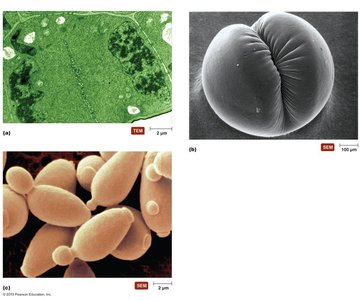
Eukaryotic reproduction is more complex than that of prokaryotes due to the presence of a nucleus and multiple chromosomes. Eukaryotes may reproduce sexually, asexually, or by both methods. The ploidy of their nuclei can be haploid (one set of chromosomes) or diploid (two sets of chromosomes).
Asexual reproduction: Involves mitosis and cytokinesis, producing genetically identical offspring.
Sexual reproduction: Involves the formation of gametes and zygotes, increasing genetic diversity.
Mitosis
Mitosis is the process by which a eukaryotic cell divides to produce two genetically identical daughter cells, maintaining the chromosome number of the parent cell. The phases of mitosis are:
Prophase
Metaphase
Anaphase
Telophase
Each phase is characterized by specific events, such as chromosome condensation, alignment, separation, and nuclear envelope reformation.
Meiosis
Meiosis is a two-stage nuclear division process that reduces the chromosome number by half, resulting in four haploid nuclei. It consists of Meiosis I and Meiosis II, each with prophase, metaphase, anaphase, and telophase. Meiosis introduces genetic variation through crossing over and independent assortment.
Meiosis I: Homologous chromosomes separate.
Meiosis II: Sister chromatids separate.
The result is four genetically distinct haploid cells.
Cytokinesis
Cytokinesis is the division of the cytoplasm, which usually occurs simultaneously with telophase. In some algae and fungi, cytokinesis may be delayed or absent, resulting in multinucleate cells.
Major Groups of Eukaryotic Microorganisms
Protozoa
Protozoa are unicellular, eukaryotic organisms that lack a cell wall and are typically motile via cilia, flagella, or pseudopods. They require moist environments and are found in aquatic habitats and moist soils. Most protozoa are not pathogenic, but some cause significant human diseases.
Key features: Eukaryotic, unicellular, lack cell wall, motile
Habitats: Ponds, lakes, oceans, moist soil, decaying matter
Ecological role: Important members of plankton
Fungi
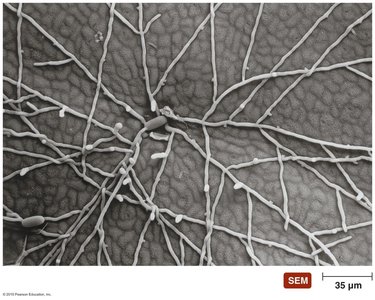
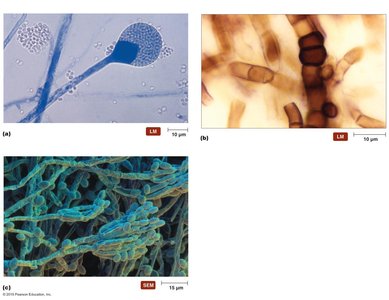
Fungi are chemoheterotrophic eukaryotes with cell walls composed of chitin. They are closely related to animals and play vital roles in decomposition, nutrient cycling, and symbiotic relationships with plants. Fungi can be unicellular (yeasts) or multicellular (molds).
Nutrition: Absorb nutrients; most are saprobes (feed on dead organic matter)
Oxygen requirements: Most are aerobic; many yeasts are facultative anaerobes
Significance: Decomposers, symbionts, food production, antibiotics, research tools, spoilage, and pathogens
Fungal Reproduction
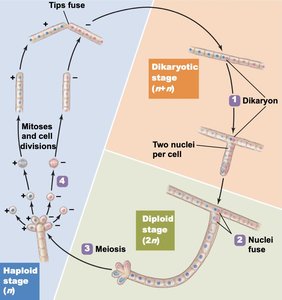
Fungi reproduce both asexually and sexually. All fungi have some form of asexual reproduction, such as budding or spore formation. Most also reproduce sexually, forming spores through the fusion of specialized cells.
Asexual reproduction: Mitosis and cytokinesis, budding, filamentous spore formation
Sexual reproduction: Fusion of nuclei, meiosis, and spore formation
Algae
Algae are simple, eukaryotic phototrophs that perform oxygenic photosynthesis using chlorophyll a. They can be unicellular, colonial, or multicellular, and most are aquatic. Algae reproduce both sexually and asexually, and all cells can become gametes during sexual reproduction.
Key features: Eukaryotic, phototrophic, aquatic
Ecological role: Primary producers in aquatic ecosystems
Water Molds
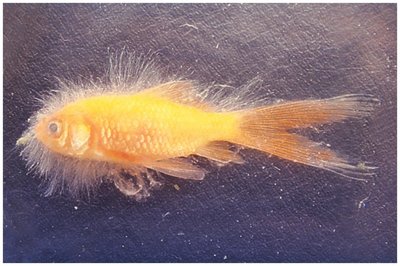
Water molds resemble fungi but differ in several key aspects. Their cell walls are composed of cellulose (not chitin), and their spores have two flagella. Water molds decompose dead animals and recycle nutrients, but some are important plant pathogens (e.g., Phytophthora infestans, which caused the Irish potato famine).
Key features: Cellulose cell walls, biflagellate spores
Ecological role: Decomposers, plant pathogens
Parasitic Helminths and Arthropod Vectors
Parasitic Helminths
Helminths are parasitic worms with microscopic infective and diagnostic stages. They are important in medical microbiology due to their role in human disease.
Arthropod Vectors
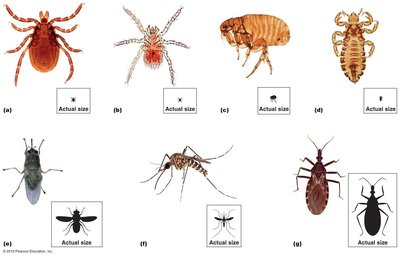
Arthropod vectors are animals that transmit pathogens between hosts. They are classified as mechanical (carry pathogens externally) or biological (pathogen develops within the vector). The two main classes are:
Arachnida: Ticks and mites (four pairs of legs)
Insecta: Fleas, lice, flies, mosquitoes, kissing bugs (three pairs of legs, three body regions)
Summary Table: Key Features of Major Eukaryotic Microorganisms
Group | Cell Wall Composition | Nutrition | Motility | Reproduction | Significance |
|---|---|---|---|---|---|
Protozoa | None | Heterotrophic | Cilia, flagella, pseudopods | Asexual/sexual | Plankton, some pathogens |
Fungi | Chitin | Chemoheterotrophic | Non-motile (most) | Asexual/sexual | Decomposers, antibiotics, pathogens |
Algae | Cellulose, silica, others | Phototrophic | Flagella (some) | Asexual/sexual | Primary producers, oxygen production |
Water Molds | Cellulose | Chemoheterotrophic | Biflagellate spores | Asexual/sexual | Decomposers, plant pathogens |
