 Back
Classification and Characteristics of Prokaryotes and Eukaryotes
Study Guide - Smart Notes
 Tailored notes based on your materials, expanded with key definitions, examples, and context.
Classification of Microorganisms
The Three-Domain System
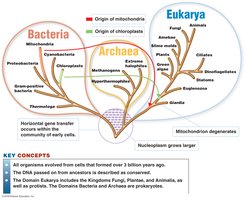
The three-domain system is a fundamental classification scheme in microbiology, dividing all life into three domains: Bacteria, Archaea, and Eukarya. This system is based on differences in ribosomal RNA (rRNA) sequences and other molecular characteristics.
Bacteria: Includes most prokaryotic organisms, characterized by peptidoglycan cell walls.
Archaea: Prokaryotes with unique membrane lipids and often found in extreme environments; lack peptidoglycan in cell walls.
Eukarya: Includes all eukaryotic organisms such as plants, animals, fungi, and protists; cells contain a nucleus and membrane-bound organelles.
Key Concepts:
All organisms evolved from cells that formed over 3 billion years ago.
Horizontal gene transfer played a significant role in early cell evolution.
The domain Eukarya includes kingdoms Fungi, Plantae, Animalia, and Protista.
Bacteria and Archaea are prokaryotes, while Eukarya are eukaryotes.
Functional Anatomy of Prokaryotic and Eukaryotic Cells
Characteristics of Archaea, Bacteria, and Eukarya
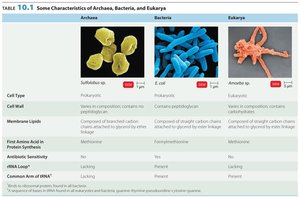
Microorganisms are classified based on their cellular structure and biochemical properties. The table below summarizes the main differences among Archaea, Bacteria, and Eukarya.
Feature | Archaea | Bacteria | Eukarya |
|---|---|---|---|
Cell Type | Prokaryotic | Prokaryotic | Eukaryotic |
Cell Wall | Varies in composition; contains no peptidoglycan | Contains peptidoglycan | Varies in composition; contains carbohydrates |
Membrane Lipids | Composed of branched carbon chains attached to glycerol by ether linkage | Composed of straight carbon chains attached to glycerol by ester linkage | Composed of straight carbon chains attached to glycerol by ester linkage |
First Amino Acid in Protein Synthesis | Methionine | Formylmethionine | Methionine |
Antibiotic Sensitivity | No | Yes | No |
rRNA Loop | Lacking | Present | Lacking |
Common Arm of tRNA | Lacking | Present | Present |
Comparison of Prokaryotic Cells and Eukaryotic Organelles
Prokaryotic Cells vs. Eukaryotic Cells and Organelles
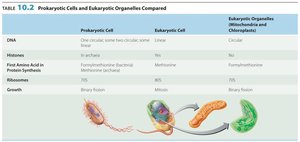
Prokaryotic cells differ from eukaryotic cells in several fundamental ways. Some eukaryotic organelles, such as mitochondria and chloroplasts, share similarities with prokaryotic cells, supporting the endosymbiotic theory of organelle origin.
Feature | Prokaryotic Cell | Eukaryotic Cell | Eukaryotic Organelles (Mitochondria & Chloroplasts) |
|---|---|---|---|
DNA | One circular; some linear | Linear | Circular |
Histones | Absent | Present | Absent |
First Amino Acid in Protein Synthesis | Formylmethionine (bacteria) | Methionine | Formylmethionine |
Ribosomes | 70S | 80S | 70S |
Growth | Binary fission | Mitosis | Binary fission |
Classification of Selected Prokaryotes
Gram-Negative Bacteria
Gram-negative bacteria are characterized by a thin peptidoglycan layer and an outer membrane containing lipopolysaccharides. They are classified based on their genetic and phenotypic properties.
Examples include Proteobacteria, Cyanobacteria, and Chlamydiae.
Gram-negative bacteria are often resistant to antibiotics due to their outer membrane.
Gram-Positive Bacteria
Gram-positive bacteria have a thick peptidoglycan layer and lack an outer membrane. They are classified into groups such as Firmicutes and Actinobacteria.
Examples include Bacillus, Staphylococcus, and Streptococcus.
Gram-positive bacteria are generally more susceptible to antibiotics targeting cell wall synthesis.
Domain: Archaea
Archaea are prokaryotes distinct from bacteria, often found in extreme environments such as hot springs, salt lakes, and anaerobic conditions.
Major groups include methanogens, halophiles, and thermophiles.
Archaea lack peptidoglycan in their cell walls and have unique membrane lipids.
Additional info: The classification of prokaryotes is based on genetic, biochemical, and structural characteristics. Modern taxonomy uses molecular techniques such as 16S rRNA sequencing to determine evolutionary relationships.
