 Back
BackEpidemiology: Patterns, Transmission, and Tracking of Infectious Diseases
Study Guide - Smart Notes
 Tailored notes based on your materials, expanded with key definitions, examples, and context.
Epidemiology
Introduction to Epidemiology
Epidemiology is the study of when and where diseases occur and how they are transmitted within populations. It is a foundational discipline in microbiology and public health, providing critical insights into disease etiology, transmission, and control.
Etiology: The cause of a disease (e.g., a specific pathogen).
Transmission: The mechanisms by which a disease spreads from one host to another.
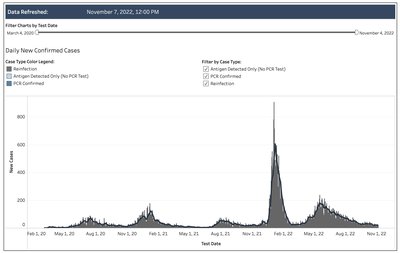
Key Epidemiological Measures
Understanding the frequency and distribution of diseases relies on several key measures:
Incidence: The number of new cases of a disease in a population during a specific time period.
Prevalence: The total number of cases (new and existing) in a population at a given time.
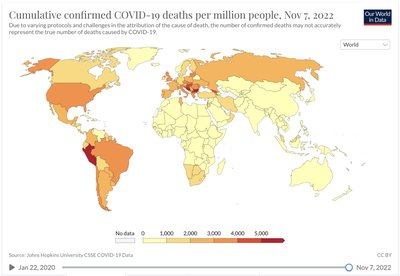
Mortality: The number of deaths caused by a disease in a population, often expressed as deaths per million people.
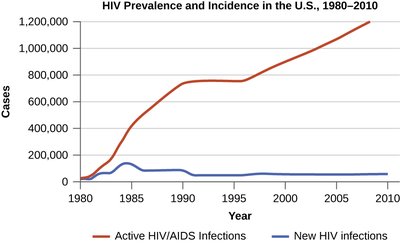
Example: The graph above shows the difference between HIV incidence (new cases) and prevalence (total cases) in the U.S. from 1980 to 2010.
Patterns of Disease Incidence
Diseases can display different patterns of occurrence within populations:
Sporadic: Occurs occasionally and irregularly (e.g., plague in the U.S.).
Endemic: Constantly present in a population or region (e.g., malaria in Nigeria).
Epidemic: A sudden increase in cases in a particular region (e.g., seasonal influenza outbreaks).
Pandemic: An epidemic that spreads across multiple continents (e.g., COVID-19, HIV/AIDS).


Other Patterns of Infectious Disease
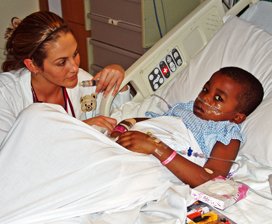
Nosocomial infections: Acquired in hospitals or healthcare facilities (e.g., Clostridioides difficile infection).
Emerging infectious diseases: Newly identified or increasing in prevalence (e.g., Ebola, COVID-19).
Reemerging infectious diseases: Previously under control but now increasing in frequency (e.g., drug-resistant tuberculosis).
Disease Transmission
The Chain of Infection
The chain of infection describes the sequence of events that allows a pathogen to move from one host to another. Breaking any link in this chain can help prevent disease transmission.
Reservoirs: Living hosts (humans, animals) or non-living environments (soil, water) where pathogens persist.
Portals of exit: Sites where pathogens leave the reservoir (e.g., respiratory tract, blood, feces).
Modes of transmission: How pathogens move to new hosts (direct contact, indirect contact, airborne, vector-borne, etc.).
Portals of entry: Sites where pathogens enter a new host (e.g., broken skin, mucous membranes).
Host susceptibility: Factors that influence a host's risk of infection (e.g., immunity, age, genetics, comorbidities).
Modes of Transmission
Direct contact: Person-to-person transmission (e.g., touching, kissing).
Indirect contact: Via fomites (inanimate objects).
Droplet transmission: Respiratory droplets over short distances.
Airborne transmission: Pathogens carried by air over longer distances.
Vector-borne transmission: Via living organisms (e.g., mosquitoes, ticks).
Vehicle transmission: Through contaminated food, water, or biological products.
Case Study: Dengue Fever Epidemiology
Dengue Fever Overview
Dengue is an acute infectious disease caused by any of four related flaviviruses (DEN-1 to DEN-4). It is transmitted primarily by Aedes mosquitoes and is endemic in many tropical regions.
Symptoms: High fever, severe headache, joint pain, rash, and in severe cases, hemorrhagic manifestations.
Diagnosis: Laboratory confirmation by virus isolation or antibody detection.
Treatment: Supportive care; no specific antiviral treatment.
Prevention: Mosquito control and personal protection; no vaccine widely available.
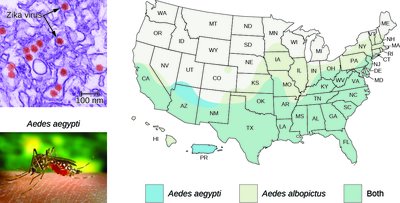
Chain of Infection for Dengue
Reservoirs: Humans (primary), monkeys (in some regions).
Portals of exit: Blood (when a mosquito bites an infected person).
Modes of transmission: Biological vector (Aedes mosquitoes).
Portals of entry: Skin (mosquito bite).
Host susceptibility: Universal; higher risk in endemic areas, no cross-immunity between serotypes.
Tracking Infectious Diseases
Notifiable Infectious Diseases
Certain diseases must be reported by healthcare workers to public health authorities to monitor and control outbreaks. Examples include COVID-19, cholera, giardiasis, and hepatitis A.
Reporting agencies: Local (e.g., county health departments), state (e.g., CDPH), national (CDC), and international (WHO).
Publications: The CDC's Morbidity and Mortality Weekly Report (MMWR) provides updates on disease trends.
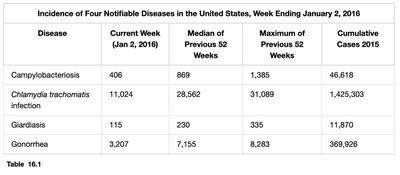
Disease | Current Week (Jan 2, 2016) | Median of Previous 52 Weeks | Maximum of Previous 52 Weeks | Cumulative Cases 2015 |
|---|---|---|---|---|
Campylobacteriosis | 406 | 869 | 1,385 | 46,618 |
Chlamydia trachomatis infection | 11,024 | 28,562 | 31,089 | 1,425,303 |
Giardiasis | 115 | 230 | 335 | 11,870 |
Gonorrhea | 3,207 | 7,155 | 8,283 | 369,926 |
Role of Health Care Workers
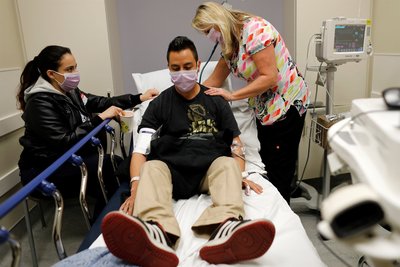
Health care workers play a critical role in tracking, reporting, and controlling infectious diseases. Their responsibilities include timely reporting of notifiable diseases, educating patients, and implementing infection control measures.

Summary Table: Patterns of Disease Incidence
Pattern | Description | Example |
|---|---|---|
Sporadic | Occasional, irregular cases | Plague in the U.S. |
Endemic | Constantly present in a region | Malaria in Nigeria |
Epidemic | Sudden increase in cases in a region | Influenza outbreaks |
Pandemic | Global epidemic | COVID-19, HIV/AIDS |
Key Equations
Incidence Rate:
Prevalence Rate:
Mortality Rate:
Additional info: These notes integrate foundational epidemiological concepts with real-world examples and current data, providing a comprehensive overview suitable for microbiology students preparing for exams or clinical practice.
