 Back
BackImmunization and Immune Testing: Principles, Types, and Applications
Study Guide - Smart Notes
 Tailored notes based on your materials, expanded with key definitions, examples, and context.
Immunization and Immune Testing
Artificial Methods of Immunity
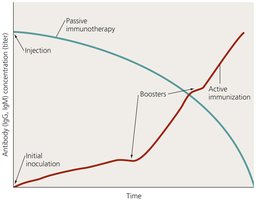
Immunity can be acquired artificially through two main methods: active immunization and passive immunotherapy. These approaches are fundamental in preventing and treating infectious diseases.
Active immunization: Administration of antigens to stimulate the patient's adaptive immune response.
Passive immunotherapy: Transfer of antibodies from an immune individual or animal to provide immediate protection.
History of Immunization
The practice of immunization has evolved over centuries, beginning with variolation in China and advancing through scientific discoveries by Jenner and Pasteur.
Variolation: Early method using material from smallpox scabs to induce immunity.
Vaccination: Edward Jenner's discovery in 1796 using cowpox to protect against smallpox.
Antibody transfer: Recognition that vaccines protect via antibody action.

Types of Vaccines
Vaccines are classified based on their composition and method of preparation. Each type has distinct advantages and limitations.
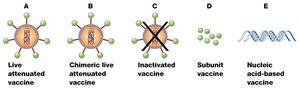
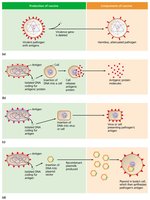
Attenuated (modified live) vaccines: Use live pathogens with reduced virulence. Provide strong, long-lasting immunity and can confer contact immunity, but may cause mild infections or disease in susceptible individuals.
Inactivated (killed) vaccines: Contain killed microbes or antigenic fragments. Safer but require multiple doses and often include adjuvants to enhance immune response.
Toxoid vaccines: Use chemically or thermally modified toxins. Effective for certain bacterial diseases but require repeated doses.
Combination vaccines: Contain antigens from several pathogens for simultaneous protection.
Recombinant gene technology vaccines: Employ recombinant DNA techniques to improve efficacy, safety, and cost.
Vaccine Manufacture and Administration
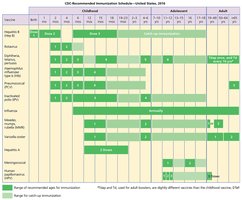
Vaccines are mass-produced using microbial cultures, often in chicken eggs. Individuals with egg allergies must avoid certain vaccines. The CDC provides a recommended immunization schedule for different age groups.
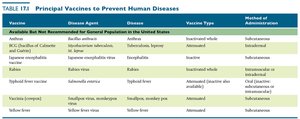
Principal Vaccines to Prevent Human Diseases
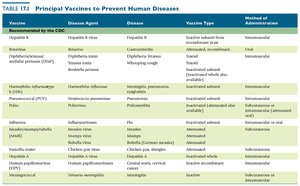
Vaccines are available for a variety of diseases, each with specific agents, types, and methods of administration.
Vaccine | Disease Agent | Disease | Vaccine Type | Method of Administration |
|---|---|---|---|---|
Hepatitis B | Hepatitis B virus | Hepatitis | Subunit | Intramuscular |
Rotavirus | Rotavirus | Gastroenteritis | Attenuated, recombinant | Oral |
Diphtheria, tetanus, pertussis (DTaP) | Corynebacterium diphtheriae, Clostridium tetani, Bordetella pertussis | Diphtheria, tetanus, pertussis | Toxoid, inactivated | Intramuscular |
Polio | Poliovirus | Poliomyelitis | Inactivated, attenuated | Subcutaneous, oral |
Influenza | Influenza virus | Flu | Inactivated, attenuated | Intramuscular, intranasal |
MMR | Measles, mumps, rubella viruses | Measles, mumps, rubella | Attenuated | Subcutaneous |
Varicella | Varicella-zoster virus | Chickenpox | Attenuated | Subcutaneous |
HPV | Human papillomavirus | Warts, cervical cancer | Subunit | Intramuscular |
Vaccine Safety
Immunization is generally safe, but may cause mild toxicity, anaphylactic shock, or residual virulence. Allegations linking vaccines to autism, diabetes, and asthma are not substantiated by research.
Passive Immunotherapy
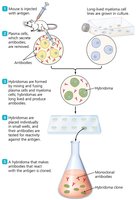
Passive immunotherapy involves administration of antiserum containing preformed antibodies for immediate protection. Limitations include allergic reactions (serum sickness), rapid antibody degradation, and lack of long-term protection. Hybridomas are used to overcome these limitations by producing monoclonal antibodies.
Serological Tests: Principles and Applications
Serology is the study of antigen-antibody interactions in blood serum. Serological tests are used to monitor infection spread and diagnose diseases.
Precipitation Tests
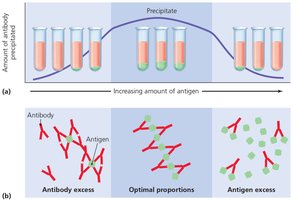
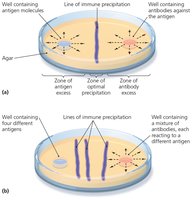
Precipitation tests detect antigen-antibody complexes (precipitates) formed in optimal proportions. Immunodiffusion is a common technique.
Turbidimetric & Nephelometric Tests
These tests measure solution cloudiness to quantify proteins in serum. Turbidimetry measures transmitted light; nephelometry measures reflected light.

Agglutination Tests
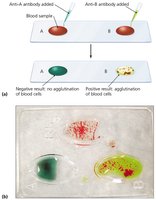
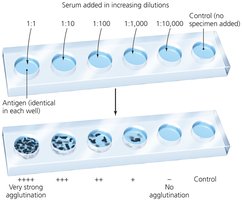
Agglutination is the clumping of insoluble particles due to antibody cross-linking. Hemagglutination is used for blood typing. Titration measures antibody levels by serial dilution.
Neutralization Tests
Viral neutralization tests determine if antibodies in serum can neutralize viruses, preventing cytopathic effects in cell cultures.
Labeled Antibody Tests
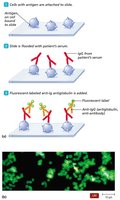
These tests use antibodies linked to detectable labels, such as fluorescent dyes. Direct and indirect fluorescent antibody tests are common.
ELISA (Enzyme-Linked ImmunoSorbent Assay)
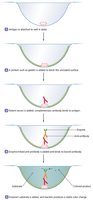
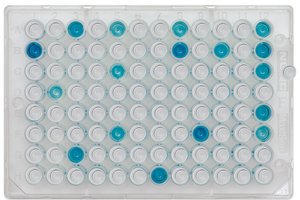
ELISA uses enzyme-labeled antibodies to detect antigens or antibodies. A color change indicates a positive result. Commonly used for serum antibody detection.
Immunoblot (Western Blot)
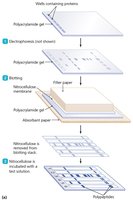
Immunoblot detects antibodies against multiple antigens. Proteins are separated by electrophoresis, transferred to a membrane, and detected by labeled antibodies.
Immunofiltration
Rapid ELISA using membrane filters for antibody binding, reducing assay time and simplifying administration. Used for rapid HIV testing.
Immunochromatography
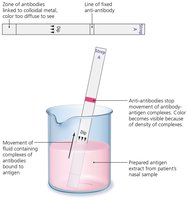
Very rapid ELISA where antigen solution flows through a porous strip, producing a visible line when immune complexes encounter specific antibodies. Used in pregnancy and rapid infection tests.
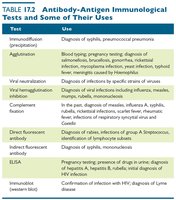
Antibody-Antigen Immunological Tests and Their Uses
Test | Use |
|---|---|
Immunofiltration | Diagnosis of syphilis, pneumococcal pneumonia |
Agglutination | Blood typing, pregnancy testing, diagnosis of infections |
Viral neutralization | Diagnosis of viral infections |
Complement fixation | Diagnosis of measles, influenza, mumps, rubella, etc. |
Direct fluorescent antibody | Diagnosis of rabies, infections of group A Streptococcus |
Indirect fluorescent antibody | Diagnosis of syphilis, mononucleosis |
ELISA | Pregnancy, HIV, hepatitis, Lyme disease |
Immunoblot (western blot) | Confirmation of HIV, Lyme disease |
Additional info: Recombinant DNA technology and monoclonal antibody production are advanced methods used to improve vaccine efficacy and immune testing accuracy.
