 Back
BackImmunization and Immunoassays: Principles and Applications
Study Guide - Smart Notes
 Tailored notes based on your materials, expanded with key definitions, examples, and context.
Immunization and Immunoassays
Introduction to Immunization
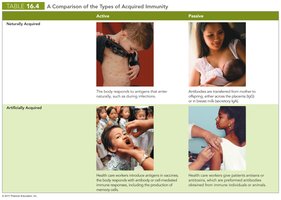
Immunization is a critical process in microbiology and public health, involving the induction of immunity to protect individuals from infectious diseases. There are two main artificial methods of immunity: active immunization and passive immunotherapy.
Active Immunization: Administration of antigens to stimulate the patient's own adaptive immune response.
Passive Immunotherapy: Transfer of preformed antibodies from an immune individual or animal to provide immediate protection.
Brief History of Immunization
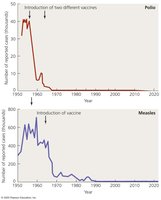
The practice of immunization dates back centuries, with early observations that survivors of smallpox did not contract the disease again. The Chinese pioneered variolation, the deliberate infection with smallpox material to induce immunity. This practice spread to England and America but was discontinued due to associated risks. Key milestones include:
1796: Edward Jenner's discovery of vaccination using cowpox to protect against smallpox.
1879: Louis Pasteur's development of a vaccine against Pasteurella multocida.
Recognition that vaccines protect through antibody action, leading to antibody transfer techniques.
Despite advances, some populations lack access to vaccines, and not all pathogens have effective vaccines. Concerns about vaccine safety can also hinder development.
Active Immunization: Vaccine Types
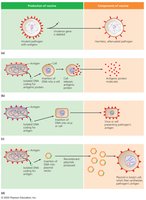
Attenuated (Modified Live) Vaccines
Attenuated vaccines use pathogens with reduced virulence, a process known as attenuation. These vaccines can cause mild infections but generally stimulate strong, long-lasting immunity and may provide contact immunity to others. However, there is a risk of residual virulence in susceptible individuals.
Inactivated (Killed) Vaccines
Inactivated vaccines are safer than live vaccines and come in two forms:
Whole Agent Vaccines: Contain inactivated whole microbes.
Subunit Vaccines: Contain antigenic fragments of microbes.
These vaccines often require multiple doses and may include adjuvants to enhance immune response.
Toxoid Vaccines
Toxoid vaccines use chemically or thermally modified toxins to stimulate immunity, particularly for bacterial diseases. They primarily induce antibody-mediated immunity and require multiple doses due to limited antigenic determinants.
Combination and Recombinant Vaccines
Combination vaccines administer antigens from several pathogens simultaneously. Recombinant DNA technology is increasingly used to create vaccines that are more effective, safer, and cheaper.
Vaccine Manufacturing and Safety
Manufacturing
Vaccines are mass-produced by culturing microbes, with viruses often grown in chicken eggs. Individuals with egg allergies must avoid certain vaccines.
Safety
Mild toxicity and risk of anaphylactic shock are possible side effects.
Attenuated vaccines may retain residual virulence.
Allegations of vaccines causing autism, diabetes, or asthma are not supported by research.
Passive Immunotherapy
Passive immunotherapy involves administering antiserum containing preformed antibodies for immediate protection. Limitations include:
Potential for allergic reactions (serum sickness).
Rapid degradation of antibodies.
No long-term protection.
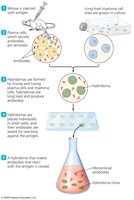
These limitations are addressed by the development of hybridomas, which produce monoclonal antibodies.
Serological Tests: Principles and Applications
Overview of Serology
Serology is the study of antigen-antibody interactions in blood serum. Serological tests are used to:
Monitor the spread of infection in populations.
Diagnose diseases by detecting specific antigens or antibodies.
Precipitation Reactions
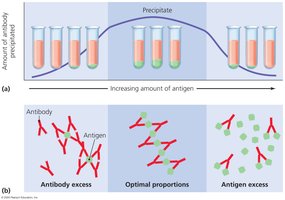
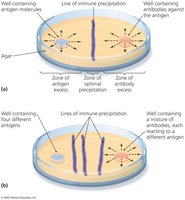
Precipitation tests are among the simplest serological assays. When antigens and antibodies are mixed in optimal proportions, they form visible precipitates (immune complexes). Immunodiffusion is a common technique for visualizing these reactions.
Agglutination Tests
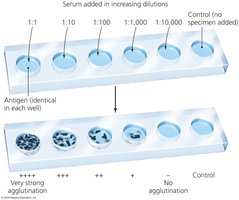
Agglutination involves the clumping of insoluble particles due to antibody cross-linking with particulate antigens. This is distinct from precipitation, which involves soluble molecules. Hemagglutination is a specific type used for blood typing. Titration is used to quantify antibody levels by serially diluting serum and observing agglutination.
Labeled Antibody Tests
Fluorescent Immunoassays
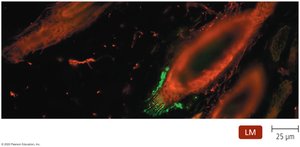
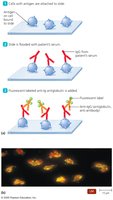
These tests use antibodies labeled with fluorescent dyes to detect antigens or antibodies. There are two main types:
Direct Fluorescent Immunoassays: Labeled antibodies bind directly to the antigen.
Indirect Fluorescent Immunoassays: Labeled secondary antibodies bind to primary antibodies attached to the antigen.
Enzyme-Linked Immunosorbent Assay (ELISA/EIA)
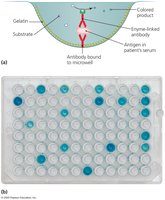
ELISA uses enzyme-labeled antibodies to detect antigens or antibodies. The enzyme reacts with a substrate to produce a colored product, indicating a positive result. ELISA can be used to detect and quantify both antigens and antibodies, is sensitive, and can be automated for high-throughput testing. The antibody sandwich ELISA is a common modification for antigen detection.
Point-of-Care and Rapid Immunoassays
Point-of-Care Testing
These are simple immunoassays that provide rapid results, useful for quick diagnosis. Examples include immunofiltration and immunochromatography assays. Immunofiltration uses antibodies bound to membrane filters, while immunochromatographic assays (such as pregnancy tests) use labeled antibodies on porous strips for rapid detection.
Summary Table: Types of Antibody-Antigen Immunological Tests
Test Type | Principle | Common Uses |
|---|---|---|
Precipitation | Antigen-antibody complexes form visible precipitates | Diagnosis of fungal infections, quantification of antigens |
Agglutination | Clumping of particles due to antibody cross-linking | Blood typing, detection of bacterial and viral infections |
Fluorescent Immunoassay | Antibodies labeled with fluorescent dyes detect antigens/antibodies | Detection of specific pathogens, autoimmune disease diagnosis |
ELISA | Enzyme-labeled antibodies produce color change upon binding | HIV testing, pregnancy testing, quantification of hormones/antibodies |
Immunochromatography | Labeled antibodies on strips produce visible lines | Rapid tests (e.g., pregnancy, infectious diseases) |
