 Back
BackInfection, Infectious Disease, and Epidemiology: Reservoirs and Transmission
Study Guide - Smart Notes
 Tailored notes based on your materials, expanded with key definitions, examples, and context.
Reservoirs of Infectious Disease
Introduction to Reservoirs
Reservoirs are sites where pathogens are maintained as a source of infection. Most pathogens cannot survive for long outside their host, so reservoirs are critical for the persistence and transmission of infectious diseases. There are three main types of reservoirs: animal, human, and nonliving.
Animal reservoirs: Animals harbor pathogens that can be transmitted to humans (zoonoses).
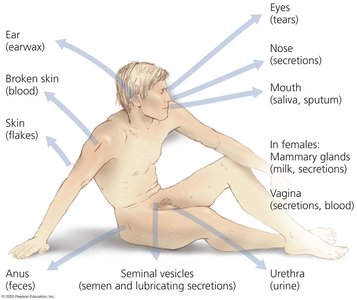
Human reservoirs: Infected individuals, including asymptomatic carriers, can transmit pathogens to others.
Nonliving reservoirs: Soil, water, and food can serve as sources of infection, often due to contamination.
Animal Reservoirs and Zoonoses
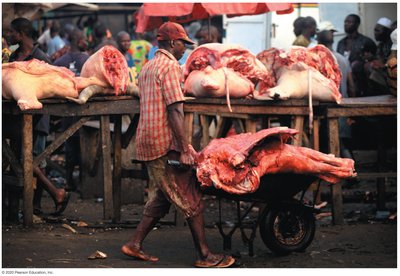
Zoonoses are diseases that are transmissible from vertebrate animals to humans. Transmission can occur through direct contact with animals or their waste, ingestion of contaminated animal products, or via bloodsucking arthropods.
Direct contact: Handling animals or their waste.
Ingestion: Eating infected animal products.
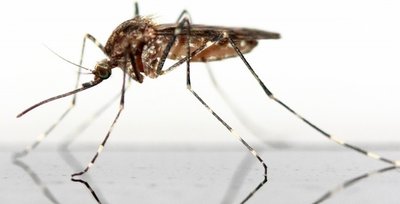
Vector-borne: Transmission by arthropods such as mosquitoes or ticks.
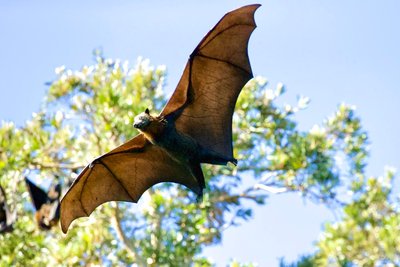
Examples of Zoonotic Diseases
Disease | Causative Agent | Animal Reservoir | Mode of Transmission |
|---|---|---|---|
Anthrax | Bacillus anthracis | Domestic livestock | Direct contact, inhalation |
Bubonic plague | Yersinia pestis | Rodents | Flea bites |
Lyme disease | Borrelia burgdorferi | Deer | Tick bites |
Rabies | Lyssavirus sp. | Bats, skunks, foxes, dogs | Bite of infected animal |
Malaria | Plasmodium spp. | Monkeys | Bite of Anopheles mosquito |
Ringworm | Trichophyton spp., Microsporum spp., Epidermophyton floccosum | Domestic animals | Direct contact |
Human Reservoirs
Humans can act as reservoirs for infectious diseases. Carriers are individuals who harbor pathogens without showing symptoms but can still transmit the disease to others. Some carriers eventually develop illness, while others remain asymptomatic due to effective immune responses.
Nonliving Reservoirs
Nonliving reservoirs include soil, water, and food. These environments can become contaminated with pathogens, often through feces or urine, and serve as sources of infection for humans and animals.
Soil: Can harbor pathogens such as Clostridium species.
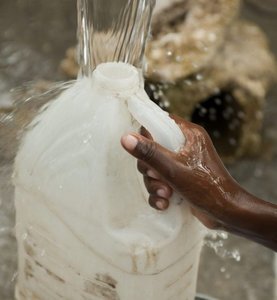
Water: May contain pathogens like Vibrio cholerae or Giardia.
Food: Improperly handled or cooked food can transmit various pathogens.
The Nature of Infectious Disease: Transmission
Modes of Disease Transmission
Pathogens can be transmitted from reservoirs to susceptible hosts through several modes:
Contact transmission: Direct, indirect, or droplet contact.
Vehicle transmission: Airborne, waterborne, or foodborne spread.
Vector transmission: Mechanical or biological vectors (e.g., insects).
Contact Transmission
Mode | Examples of Diseases Spread |
|---|---|
Direct contact (e.g., handshaking, kissing, bites) | Anthrax, genital warts, gonorrhea, herpes, rabies, syphilis |
Indirect contact (e.g., fomites like drinking glasses, toys) | Common cold, influenza, measles, pneumonia, tetanus |
Droplet transmission (e.g., sneezing within 1 meter) | Whooping cough, strep throat |
Vehicle Transmission
Mode | Examples of Diseases Spread |
|---|---|
Airborne (dust or droplets >1 meter) | Chickenpox, influenza, tuberculosis |
Waterborne (streams, pools) | Cholera, Giardia diarrhea |
Foodborne (poultry, meat, seafood) | Botulism, hepatitis A, tapeworms |
Vector Transmission
Mode | Examples of Diseases Spread |
|---|---|
Mechanical (on bodies of flies, roaches) | E. coli diarrhea, salmonellosis |
Biological (lice, mosquitoes, ticks) | Chagas’ disease, malaria, plague, yellow fever |
Invasion and Establishment of Disease
Events in Establishing an Infectious Disease
The process of infection involves several key events:
Encounter: Host comes into contact with the pathogen.
Entry (and multiplication): Pathogen enters the host and begins to multiply.
Disease process: Pathogen causes damage, leading to symptoms.
Spread: Pathogen may disseminate within the host or to new hosts.
Damage: Host tissues are harmed by the pathogen or immune response.
Outcome: Recovery, chronic infection, or death.
Portals of Entry
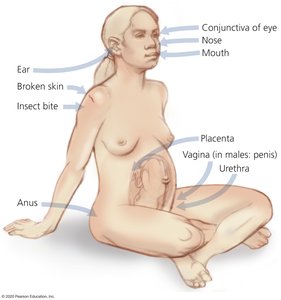
Pathogens enter the body through specific portals of entry. The three major pathways are:
Skin: Through cuts, abrasions, or direct penetration.
Mucous membranes: Lining the respiratory, gastrointestinal, and urogenital tracts.
Placenta: Some pathogens can cross the placenta to infect the fetus.
Parenteral Route
The parenteral route is not a true portal of entry but refers to the direct deposition of pathogens into tissues beneath the skin or mucous membranes, often through punctures, bites, or injections. This route circumvents the body's usual barriers to infection.
Key Terms and Concepts
Fomite: An inanimate object involved in the indirect transmission of pathogens (e.g., doorknobs, utensils).
Airborne transmission: Spread of pathogens via droplets or dust particles that travel more than 1 meter from the source.
Vector: An organism, typically an arthropod, that transmits a pathogen from one host to another.
Example Questions
Chagas disease is transmitted by a bug with mouthparts that penetrate blood vessels. Which type of exposure does this represent? Answer: Parenteral route
Fomites are: Inanimate objects involved in the indirect transmission of pathogens
If one person sneezes, transmitting a virus to another person more than 1 meter away, that is an example of: Airborne transmission
Additional info: This summary integrates and expands upon the provided lecture slides, adding definitions, examples, and context for microbiology students studying infectious disease epidemiology.
