 Back
BackInfection, Infectious Diseases, and Epidemiology – Study Guide
Study Guide - Smart Notes
 Tailored notes based on your materials, expanded with key definitions, examples, and context.
Infection, Infectious Diseases, and Epidemiology
Introduction to Infection and Disease
Understanding the principles of infection and disease is fundamental in microbiology. This section covers the definitions, classifications, and mechanisms by which pathogens cause disease, as well as the epidemiological methods used to study their spread.
Key Definitions and Concepts
Infection: Colonization of the body by pathogens.
Disease: An abnormal state in which the body is not functioning normally.
Pathogen: A microorganism capable of causing disease.
Pathology: The study of disease.
Pathogenesis: The development of disease.
Symptom: Subjective evidence of disease (e.g., pain, fatigue).
Sign: Objective evidence of disease (e.g., fever, rash).
Syndrome: A group of symptoms and signs that characterize a disease.
Normal Microbiota and Opportunistic Pathogens
The human body hosts a variety of microorganisms, collectively known as the microbiome. These organisms are typically harmless and may even benefit the host, but under certain conditions, they can become opportunistic pathogens.
Resident microbiota: Permanently colonize the host and do not cause disease under normal conditions.
Transient microbiota: Present for a short time; cannot persist due to competition or host defenses.
Opportunistic pathogens: Normal microbiota that cause disease only under specific conditions (e.g., immune suppression, introduction to unusual sites, changes in microbiota).
Microbial antagonism: Competition between microbes that helps protect the host.
Examples of conditions where normal microbiota can cause disease:
Immune suppression (e.g., chemotherapy, HIV infection)
Introduction into unusual body sites (e.g., E. coli from gut to urinary tract)
Changes in the normal microbiota (e.g., antibiotic use)
Symbiosis and Microbial Relationships
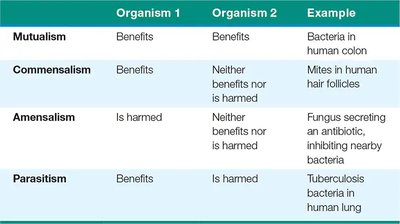
Microorganisms interact with their hosts in various ways, described as types of symbiosis:
Organism 1 | Organism 2 | Example |
|---|---|---|
Mutualism | Benefits | Bacteria in human colon |
Commensalism | Neither benefits nor is harmed | Mites in human hair follicles |
Amensalism | Is harmed | Fungus secreting antibiotic, inhibiting nearby bacteria |
Parasitism | Is harmed | Tuberculosis bacteria in human lung |
Reservoirs of Infectious Diseases
Reservoirs are sites where pathogens are maintained as sources of infection. There are three main types:
Animal reservoirs: Zoonotic diseases are naturally spread from animals to humans (e.g., rabies, Lyme disease).
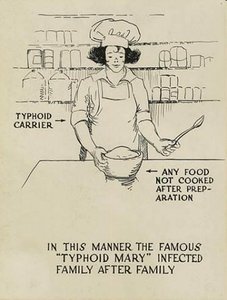
Human carriers: Infected individuals who are asymptomatic but can transmit the pathogen (e.g., Typhoid Mary).
Non-living reservoirs: Soil, water, and food contaminated with pathogens (e.g., Clostridium in soil, Salmonella in water).
Portals of Entry and Exit
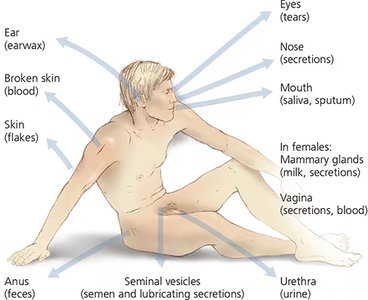
Pathogens enter and exit the host through specific portals, which are often the same for both processes. Common portals include:
Skin (broken skin, hair follicles)
Mucous membranes (respiratory, gastrointestinal, urogenital tracts)
Placenta
Parenteral route (direct deposition into tissues via medical procedures)
Virulence Factors of Infectious Agents
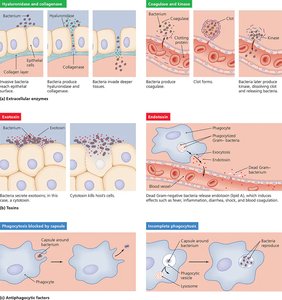
Virulence factors are molecules produced by pathogens that contribute to their ability to cause disease. These include:
Adhesion proteins
Biofilms
Extracellular enzymes (e.g., coagulase, collagenase, hyaluronidase)
Toxins (exotoxins and endotoxins)
Capsules (inhibit phagocytosis)
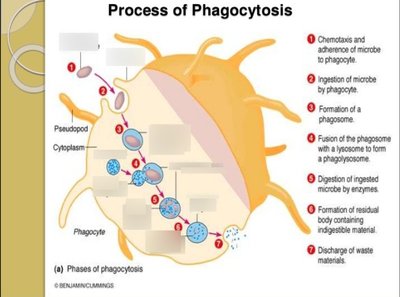
Process of Phagocytosis
Phagocytosis is a key immune defense mechanism. The steps include:
Chemotaxis and adherence of microbe to phagocyte
Ingestion of microbe by phagocyte
Formation of a phagosome
Fusion of the phagosome with a lysosome to form a phagolysosome
Digestion of ingested microbe by enzymes
Formation of residual body containing indigestible material
Discharge of waste materials
Toxins: Exotoxins vs. Endotoxins
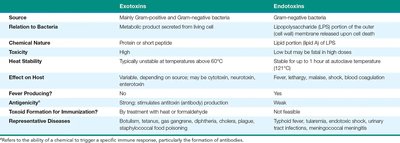
Toxins are chemicals produced by pathogens that harm host tissues or trigger damaging immune responses. There are two main types:
Feature | Exotoxins | Endotoxins |
|---|---|---|
Source | Gram-positive and Gram-negative bacteria | Gram-negative bacteria |
Chemical Nature | Protein or short peptide | Lipid (lipid A of LPS) |
Toxicity | High | Low, but fatal in high doses |
Heat Stability | Unstable above 60°C | Stable up to 121°C |
Effect on Host | Varied (cytotoxin, neurotoxin, enterotoxin) | Fever, shock, blood coagulation |
Fever Producing? | No | Yes |
Representative Diseases | Botulism, tetanus, diphtheria, cholera | Typhoid fever, meningococcal meningitis |
Modes of Disease Transmission
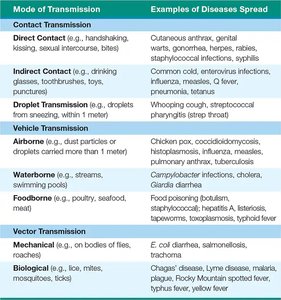
Pathogens can be transmitted through various routes:
Contact transmission: Direct (person-to-person), indirect (fomites), droplet (coughing, sneezing)
Vehicle transmission: Airborne, waterborne, foodborne, bodily fluids
Vector transmission: Biological (e.g., mosquitoes), mechanical (e.g., flies)
Classification of Infectious Diseases
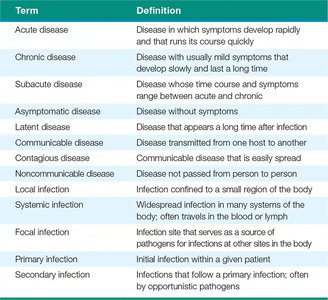
Diseases can be classified by their occurrence, duration, and extent:
Term | Definition |
|---|---|
Acute disease | Symptoms develop rapidly and run their course quickly |
Chronic disease | Symptoms develop slowly and last a long time |
Subacute disease | Symptoms between acute and chronic |
Latent disease | Period of no symptoms when the agent is inactive |
Systemic infection | Infection throughout the body |
Local infection | Confined to a small area |
Primary infection | Initial infection in a patient |
Secondary infection | Follows a primary infection, often by opportunists |
Occurrence and Epidemiology of Disease
Epidemiology is the study of where and when diseases occur and how they are transmitted. Key terms include:
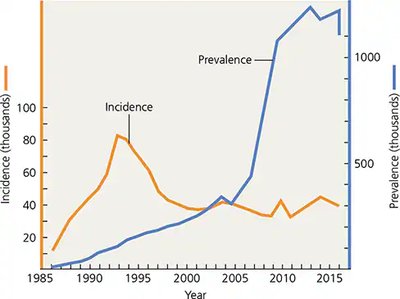
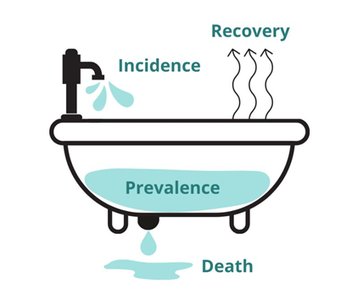
Incidence: Number of new cases in a population during a specific time period.
Prevalence: Total number of cases (new and existing) in a population at a given time.
Endemic: Constantly present in a population.
Sporadic: Occurs occasionally.
Epidemic: Many hosts in a given area in a short time.
Pandemic: Worldwide epidemic.
Nosocomial (Healthcare-Associated) Infections
Nosocomial infections are acquired in healthcare settings. They can be classified as:
Exogenous: Acquired from the healthcare environment.
Endogenous: Arise from normal microbiota within the patient.
Iatrogenic: Result from medical procedures.
Superinfections: Occur when antimicrobial drugs inhibit resident microbiota, allowing other microbes to thrive.
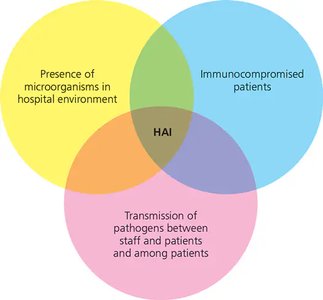
Prevention: Handwashing is the most effective way to reduce healthcare-associated infections.
Notifiable Infectious Diseases
Certain diseases must be reported to public health authorities. Examples include AIDS, anthrax, botulism, cholera, diphtheria, hepatitis, measles, mumps, pertussis, rabies, salmonellosis, and tuberculosis.
Famous Figures in Epidemiology
Joseph Lister: Introduced surgical antisepsis.
Ignaz Semmelweis: Advocated handwashing to prevent puerperal fever.
John Snow: "Father of Epidemiology," traced cholera outbreak to contaminated water.
Mary Mallon ("Typhoid Mary"): Asymptomatic carrier of Salmonella typhi, infected many as a cook.
Additional Tables and Examples
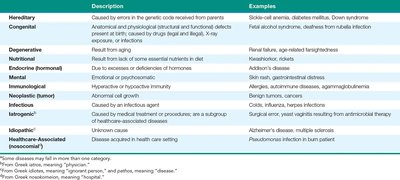
Types of Diseases
Type | Description | Examples |
|---|---|---|
Hereditary | Genetic causes | Sickle-cell anemia, Down syndrome |
Congenital | Structural/functional defects at birth | Fetal alcohol syndrome |
Degenerative | Aging-related | Renal failure |
Nutritional | Lack of essential nutrients | Rickets |
Endocrine | Hormonal excess/deficiency | Addison's disease |
Mental | Emotional/psychosomatic | Stress-related GI issues |
Immunological | Immune dysfunction | Allergies, autoimmune diseases |
Neoplastic | Abnormal cell growth | Benign/malignant tumors |
Infectious | Caused by infectious agent | Flu, tuberculosis |
Iatrogenic | Result of medical procedure | Drug-induced anemia |
Idiopathic | Unknown cause | Alzheimer's disease |
Healthcare-Associated | Acquired in healthcare setting | Pseudomonas infection in burn patient |
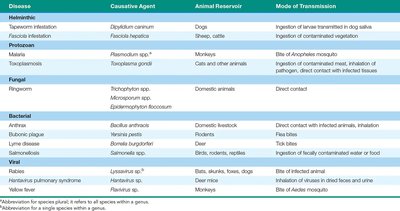
Animal Reservoirs and Zoonoses
Disease | Causative Agent | Animal Reservoir | Mode of Transmission |
|---|---|---|---|
Tapeworm Infestation | Dipylidium caninum | Dogs | Ingestion of larvae in dog saliva |
Malaria | Plasmodium spp. | Monkeys | Bite of Anopheles mosquito |
Ringworm | Microsporum spp. | Domestic animals | Direct contact |
Rabies | Lyssavirus spp. | Bats, skunks, foxes, dogs | Bite of infected animal |
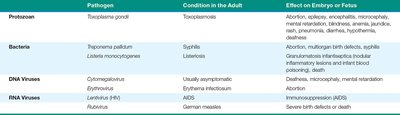
Pathogens and Effects on Embryo or Fetus
Pathogen | Condition in Adult | Effect on Embryo or Fetus |
|---|---|---|
Toxoplasma gondii | Toxoplasmosis | Abortion, epilepsy, encephalitis, microcephaly, etc. |
Treponema pallidum | Syphilis | Abortion, birth defects, mental retardation |
Cytomegalovirus | Usually asymptomatic | Deafness, microcephaly, mental retardation |
Rubivirus | German measles | Severe birth defects or death |
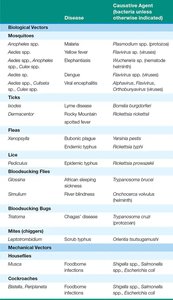
Biological and Mechanical Vectors
Vector | Disease | Causative Agent |
|---|---|---|
Anopheles mosquito | Malaria | Plasmodium spp. |
Ixodes tick | Lyme disease | Borrelia burgdorferi |
Flea | Bubonic plague | Yersinia pestis |
Louse | Epidemic typhus | Rickettsia prowazekii |
Modes of Transmission
Mode of Transmission | Examples of Diseases Spread |
|---|---|
Direct Contact | Cutaneous anthrax, genital warts, herpes, rabies |
Indirect Contact | Common cold, influenza, measles |
Droplet Transmission | Whooping cough, strep throat |
Airborne | Chickenpox, tuberculosis |
Waterborne | Giardiasis, cholera |
Foodborne | Food poisoning, hepatitis A |
Mechanical Vector | E. coli diarrhea, salmonellosis |
Biological Vector | Chagas' disease, malaria, typhus |
Summary
This guide provides a comprehensive overview of infection, infectious diseases, and epidemiology, including the roles of normal microbiota, reservoirs, transmission, virulence factors, and the classification and occurrence of diseases. Understanding these concepts is essential for preventing and controlling infectious diseases in clinical and public health settings.
