 Back
BackInnate Immunity: The Complement System, Inflammation, and Fever
Study Guide - Smart Notes
 Tailored notes based on your materials, expanded with key definitions, examples, and context.
Innate Immunity: Second Line of Defense
Overview of Innate Immunity
The innate immune system provides the body with immediate, nonspecific defense mechanisms against pathogens. The second line of defense includes cellular and chemical barriers that act when pathogens bypass the first line (skin and mucous membranes). Key components include the complement system, inflammation, and fever.
Complement System
Definition and Function
The complement system is a group of plasma proteins that, when activated, trigger a cascade of antimicrobial responses. These responses include direct lysis of pathogens (cytolysis), opsonization (enhanced phagocytosis), inflammation, and fever. The complement system is a crucial part of innate immunity and bridges to adaptive immunity.
Cytolysis: Destruction of foreign cells by forming membrane attack complexes.
Opsonization: Coating of pathogens to enhance phagocytosis.
Inflammation: Recruitment of immune cells and increased vascular permeability.
Fever: Indirectly promoted by complement activation.
Pathways of Complement Activation
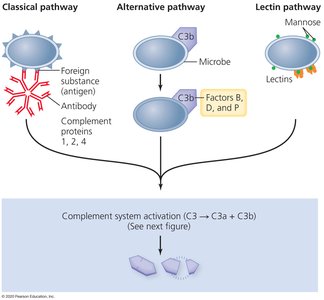
Complement activation can occur via three distinct pathways, all converging to activate C3, a central component of the cascade:
Classical Pathway: Triggered by antigen-antibody complexes.
Alternative Pathway: Initiated by direct interaction with microbial surfaces.
Lectin Pathway: Activated by mannose-binding lectins binding to pathogen surfaces.
The Complement Cascade
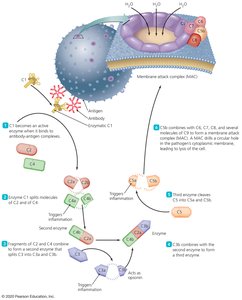
Each pathway leads to the cleavage of complement protein C3 into C3a and C3b. This triggers a cascade resulting in the formation of the membrane attack complex (MAC), which creates pores in the pathogen's membrane, leading to cell lysis.
Outcomes of Complement Activation
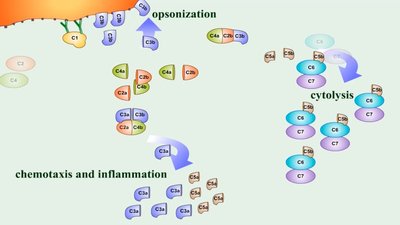
Cytolysis: Formation of the MAC (C5b, C6, C7, C8, C9) leads to cell lysis.
Opsonization: C3b binds to pathogen surfaces, enhancing phagocytosis.
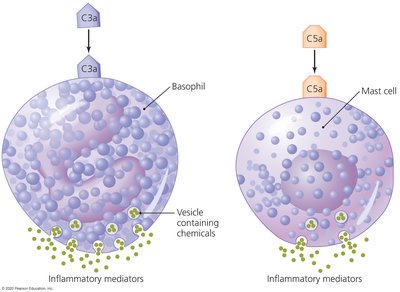
Inflammation: Fragments such as C3a, C4a, and C5a act as inflammatory mediators, recruiting immune cells and increasing vascular permeability.
Membrane Attack Complex (MAC)
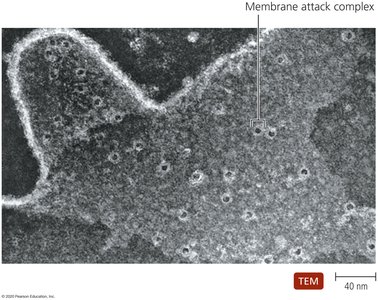
The MAC is a structure formed by complement proteins that inserts into the pathogen's membrane, creating pores and causing cell death.
Inflammatory Mediators
Complement fragments C3a and C5a are potent inflammatory mediators. They stimulate basophils and mast cells to release histamine and other chemicals, amplifying the inflammatory response.
Inflammation
Definition and Characteristics
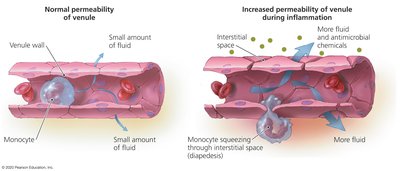
Inflammation is a nonspecific response to tissue damage caused by infection, injury, or other insults. It is characterized by redness, heat, swelling, and pain. The main functions of inflammation are to destroy the injurious agent, localize the response, and repair damaged tissue.
Acute Inflammation: Rapid onset, short duration, typically beneficial.
Chronic Inflammation: Prolonged, can lead to tissue damage and disease.
Mechanisms of Inflammation
Vasodilation: Increased blood flow causes redness and heat.
Increased Vascular Permeability: Allows immune cells and proteins to enter tissues, causing swelling.
Chemical Mediators: Bradykinins, prostaglandins, leukotrienes, and histamine trigger and sustain inflammation.
Fever
Definition and Mechanism
Fever is an elevation of body temperature above 37°C, induced by pyrogens that act on the hypothalamus. Pyrogens include bacterial toxins, cytoplasmic contents, antibody-antigen complexes, and substances released by phagocytes after ingesting bacteria.
Benefits of Fever: Enhances interferon effects, inhibits growth of some microbes, and may enhance phagocyte activity and tissue repair.
Key Terms and Concepts
Opsonization: The process by which pathogens are coated with molecules (e.g., C3b) that enhance their uptake by phagocytes.
Cytolysis: The destruction of cells by the formation of pores in their membranes.
Pyrogens: Substances that induce fever by acting on the hypothalamus.
Inflammatory Mediators: Chemicals such as histamine, bradykinin, and prostaglandins that promote inflammation.
Summary Table: Complement Pathways and Outcomes
Pathway | Trigger | Key Proteins | Main Outcomes |
|---|---|---|---|
Classical | Antigen-antibody complexes | C1, C2, C4 | C3 activation, opsonization, cytolysis, inflammation |
Alternative | Microbial surfaces | Factors B, D, P | C3 activation, opsonization, cytolysis, inflammation |
Lectin | Mannose on pathogen surfaces | Lectins | C3 activation, opsonization, cytolysis, inflammation |
Sample Questions and Answers
Which complement fragments are inflammatory? C3a, C4a, and C5a are all inflammatory mediators.
Which pathway of complement activation acts in conjunction with antibodies? The classical pathway.
Which inflammatory mediator is released by mast cells? Histamine.
