 Back
BackMBY 261 Mycology: Study Guide and Semester Structure
Study Guide - Smart Notes
 Tailored notes based on your materials, expanded with key definitions, examples, and context.
MBY 261 Mycology: Study Guide and Semester Structure
Introduction
This study guide provides an overview of the MBY 261 Mycology module, which is part of the Microbiology curriculum at the University of Pretoria. The module introduces students to the fundamental principles of mycology, including fungal structure, metabolism, diversity, genetics, ecology, and biotechnology. The course is structured into 15 study units, each focusing on a specific aspect of fungal biology, and includes both theoretical lectures and practical laboratory sessions.
Module Overview
Purpose and Outcomes
Purpose: To provide a broad understanding of the structure, metabolism, classification, growth, and diversity of fungi, as well as their interactions with other organisms and basic fungal genetics and genomics.
Outcomes:
Understand the composition and structure of fungi.
Comprehend fungal growth, control, and diversity.
Apply genetic and genomic concepts to fungi and oomycetes.
Integrate mycological knowledge into Microbiology, Plant Pathology, and Medical Sciences.
Module Structure
Lecture and Practical Schedule
The module is divided into 15 study units, each with specific learning outcomes. Lectures are held twice a week, and practicals are scheduled every second week. The practical component is essential for hands-on experience in fungal isolation, identification, and experimental techniques.
Lecture Topics (Study Units)
SU 1: Introduction to Fungi
SU 2: Fungal Structures (Differentiation, Development & Conidiogenesis)
SU 3: Fungal Growth, Nutrient and Environmental Conditions
SU 4: Fungal Spores, Dormancy and Dispersal
SU 5: Diversity of Fungi (Ascomycota, Basidiomycota, Mucoromycota, Oomycota)
SU 6: Sex in Fungi
SU 7: Fungal Ecology & Decomposing Fungi
SU 8: Fungal Symbiosis
SU 9: Parasitic Fungi of Insects
SU 10: Parasitic Fungi of Nematodes
SU 11: Plant Pathogenic Fungi and Oomycetes
SU 12: Mycotoxins
SU 13: Fungi of Human Medical Interest
SU 14: Fungal Genetics and Omics
SU 15: Fungi in Biotechnology
Practical Sessions
Prac 1: Lab Safety and Isolation of Micro-organisms
Prac 2: Purification and Identification of Micro-organisms using Microscopy
Prac 3: Molecular Identification of Fungal Isolate (Tutorial)
Prac 4: Biocontrol of Phytopathogenic Fungi
Assessment Structure
Semester Test 1: Covers Study Units 1–6
Semester Test 2: Covers Study Units 7–12
Class Tests: Three MCQ tests covering different study units
Practical Assignments/Tests: Four practicals, each contributing to the semester mark
Final Examination: Covers all 15 study units
Detailed Semester Planner
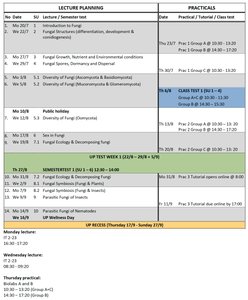
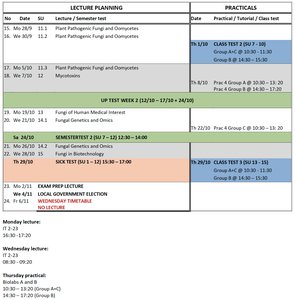
The semester planner provides a week-by-week breakdown of lecture topics, practical sessions, and assessment dates. This helps students manage their time and prepare for each component of the module.
Week | Lecture Topics (SU) | Practical / Test |
|---|---|---|
1 | Introduction to Fungi | Prac 1 (Lab Safety & Isolation) |
2 | Fungal Structures | Prac 1 (cont.) |
3 | Fungal Growth, Nutrient and Environmental Conditions | Prac 2 (Purification & Microscopy) |
4 | Fungal Spores, Dormancy and Dispersal | Prac 2 (cont.) |
5 | Diversity of Fungi | Class Test 1 |
6 | Sex in Fungi | Prac 3 (Molecular Identification) |
7 | Fungal Ecology & Decomposing Fungi | Prac 3 (cont.) |
8 | Fungal Symbiosis | Semester Test 1 |
9 | Parasitic Fungi of Insects | Prac 4 (Biocontrol) |
10 | Parasitic Fungi of Nematodes | Prac 4 (cont.) |
11 | Plant Pathogenic Fungi and Oomycetes | Class Test 2 |
12 | Mycotoxins | Prac 4 (cont.) |
13 | Fungi of Human Medical Interest | Semester Test 2 |
14 | Fungal Genetics and Omics | Class Test 3 |
15 | Fungi in Biotechnology | Exam Prep Lecture |
Key Study Units and Learning Outcomes
Fungal Structure and Function: Understanding hyphae, mycelium, cell wall composition, and fungal dimorphism.
Fungal Growth and Metabolism: Spore germination, nutrient acquisition, and environmental influences on growth.
Diversity and Classification: Major fungal phyla, reproductive strategies, and life cycles.
Fungal Ecology and Symbiosis: Roles in decomposition, mutualistic relationships, and ecological strategies.
Pathogenic Fungi: Plant and animal pathogens, mechanisms of infection, and disease management.
Fungal Genetics and Biotechnology: Genomics, genetic variation, and applications in industry and research.
Additional Information
All practicals are compulsory and contribute to the final semester mark.
Students are expected to prepare for lectures and practicals by reviewing materials posted online.
Assessment emphasizes understanding, integration, and application of concepts.
